Iconography · Civilisational Standard · Non-violent
நடுகல் புலி
The Watching Tiger of the Hero-Stone
The land remembers. The tiger watches. The flame does not go out.
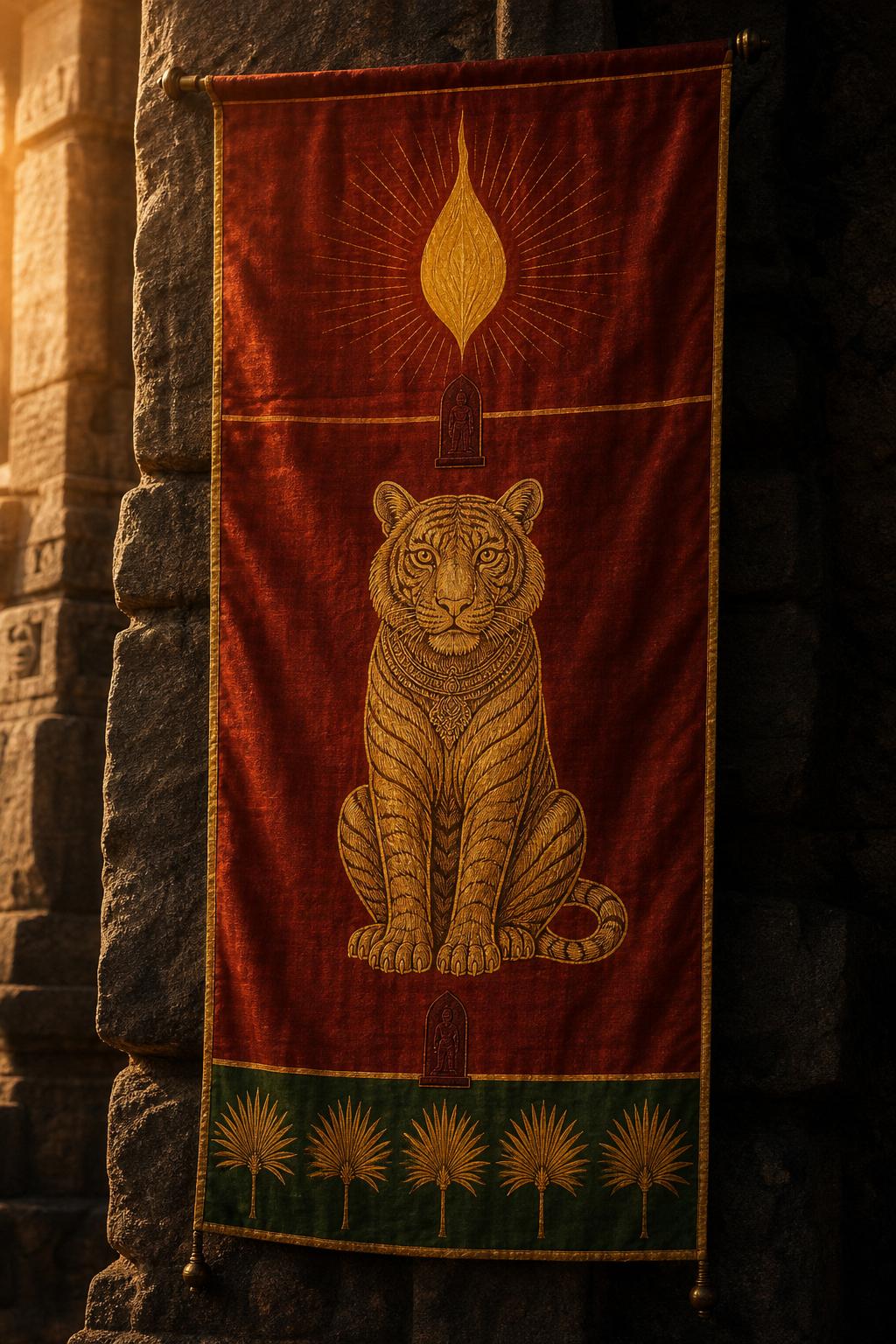
Reference standard · anime-realism register · Chola guardian-tiger posture · drawn from Brihadeeswarar temple iconography (1010 CE) and Sangam naṭukal tradition. No proscribed insignia.
VS-ICON-PULIKODI-001Tradition I
The Hero-Stone
நடுகல்
Sangam-era memorial stones, c. 300 BCE onward. Erected by villages for any person who fell protecting the community — pastoralist, mother, kin. The original Tamil practice of remembrance, documented in Puṟanāṉūṟu and excavated across Tamil Nadu and the north-east.
Tradition II
The Watching Tiger
காவல் புலி
The Chola tiger is the imperial standard of one of the world's longest-ruling Tamil dynasties (c. 850–1279 CE). Here drawn in the seated guardian (yāḷi) posture from Brihadeeswarar temple, Thanjavur — eyes open, paws together, mouth closed. Memory, not war.
Tradition III
The Flame
தீபம்
The Karthigai deepam — oldest Tamil festival lamp, lit for the departed and the living. The flame says: the line of continuity was not broken; what was kept alive is still alive.
What this standard explicitly refuses
- The roaring-tiger-head composite designed for the LTTE in 1977 (Natarajan of Madurai).
- The crossed rifles, bayonets, encircling bullet-ring, and "Liberation Tigers of Tamil Eelam" wordmark.
- Red field arranged in the LTTE flag composition. This standard uses ochre / gold / palmyra-green, not LTTE crimson-and-yellow.
- Uniforms, rank tabs, salutes, drill — any combatant framing of the tiger.
- Any depiction of the tiger as attacking, snarling, or weaponised. This tiger sits and watches.
- Naming of any individual combatant of a proscribed organisation alongside the standard.
UK Terrorism Act 2000 s.13 prohibits arousing reasonable suspicion of LTTE support through display of LTTE iconography. It does not — and cannot — prohibit the Chola Puli Koḍi, the Sangam hero-stone tradition, the Karthigai flame, or the palmyra. These are documented Tamil civilisational symbols pre-dating the LTTE by roughly 1,100 years (Chola coinage), 2,300 years (Sangam corpus), and immemorially (palmyra).
The மூவேந்தர் triad — context
Classical Tamil polity recognised three crowned dynasties: Chola (புலி · tiger), Pandya (மீன் · twin-fish), and Chera (வில் · bow). Together they are the mūvēndar. The tiger never stood alone in Tamil civilisational memory — it stood beside the fish and the bow, in a constellation of polities, not a single combatant flag. Naṭukal Puli inherits the tiger from that constellation, not from 1977.
Scholarly anchors
- Tier AThe Cōḷas (2 vols)K.A. Nilakanta Sastri · University of Madras · 1935 / rev. 1955
- Tier AArt of the Imperial CholasVidya Dehejia · Columbia University Press · 1990
- Tier AThe Poems of Ancient Tamil: Their Milieu and Their Sanskrit CounterpartsGeorge L. Hart · University of California Press · 1975
- Tier AThe Four Hundred Songs of War and Wisdom: An Anthology from the PuṟanāṉūṟuG. Hart & H. Heifetz · Columbia University Press · 1999
- Tier AThe Smile of Murugan: On Tamil Literature of South IndiaKamil Zvelebil · Brill · 1973
- Tier ATamil Literature (HOS II.1)Kamil Zvelebil · Brill · 1975
- Tier AThe Coinage and History of South India, vol. II (Chola catalogue, Govt. Museum Chennai)Michael Mitchiner · Hawkins Publications · 1998
- Tier AEarly Tamil EpigraphyIravatham Mahadevan · Harvard Oriental Series · 2003
- Tier AMemorial Stones: A Study of their Origin, Significance and Variety (naṭukal tradition)S. Settar & G.D. Sontheimer (eds) · IGNCA / South Asia Institute Heidelberg · 1982
- Tier AHero Stones and the Cult of the Hero in Tamil NaduK. Rajan · Indian Archaeological Society, Studies in History · 2000
- Tier AThe Brihadisvara Temple at Tanjavur (UNESCO World Heritage; Chola murals & guardian-tiger reliefs)UNESCO World Heritage Centre · Inscribed 1987 / extended 2004
- Tier BCounterpoint: Essays in Archaeology and Heritage Studies — Chola coin tiger emblemR. Champakalakshmi · IGNCA · 2011
- Tier BTamil sub-nationalist symbols: a historical analysisN. Manoharan · Institute of Peace & Conflict Studies · 2007
A note on the LTTE flag (1977)
The flag designed for the LTTE in 1977 by Natarajan of Madurai is a 20th-century military emblem that appropriated the older Chola tiger and recomposed it with rifles, bayonets, and bullets. It is proscribed in the United Kingdom under the Terrorism Act 2000 (Schedule 2) and Veli Studies will never depict, stylise, reinterpret, or partially reproduce it on any public surface. Reclaiming the Chola Puli Koḍi is the opposite movement: it returns the tiger to its civilisational ground and refuses the rifles.
Return
Veli Studies · the study set
Read next
What this study set refuses · the Five Refusals