Parchment rots. Vellum burns. Paper — that European latecomer — dissolves at the first monsoon. The palm-leaf, cut from the Palmyra or the Talipot, cured in turmeric water, incised with a fine iron stylus and rubbed with soot to bring the letters up, will outlive them all. In the humid south, a leaf treated correctly can hold a text legibly for six hundred years. In the Cittar and Sangam corpora, some do.
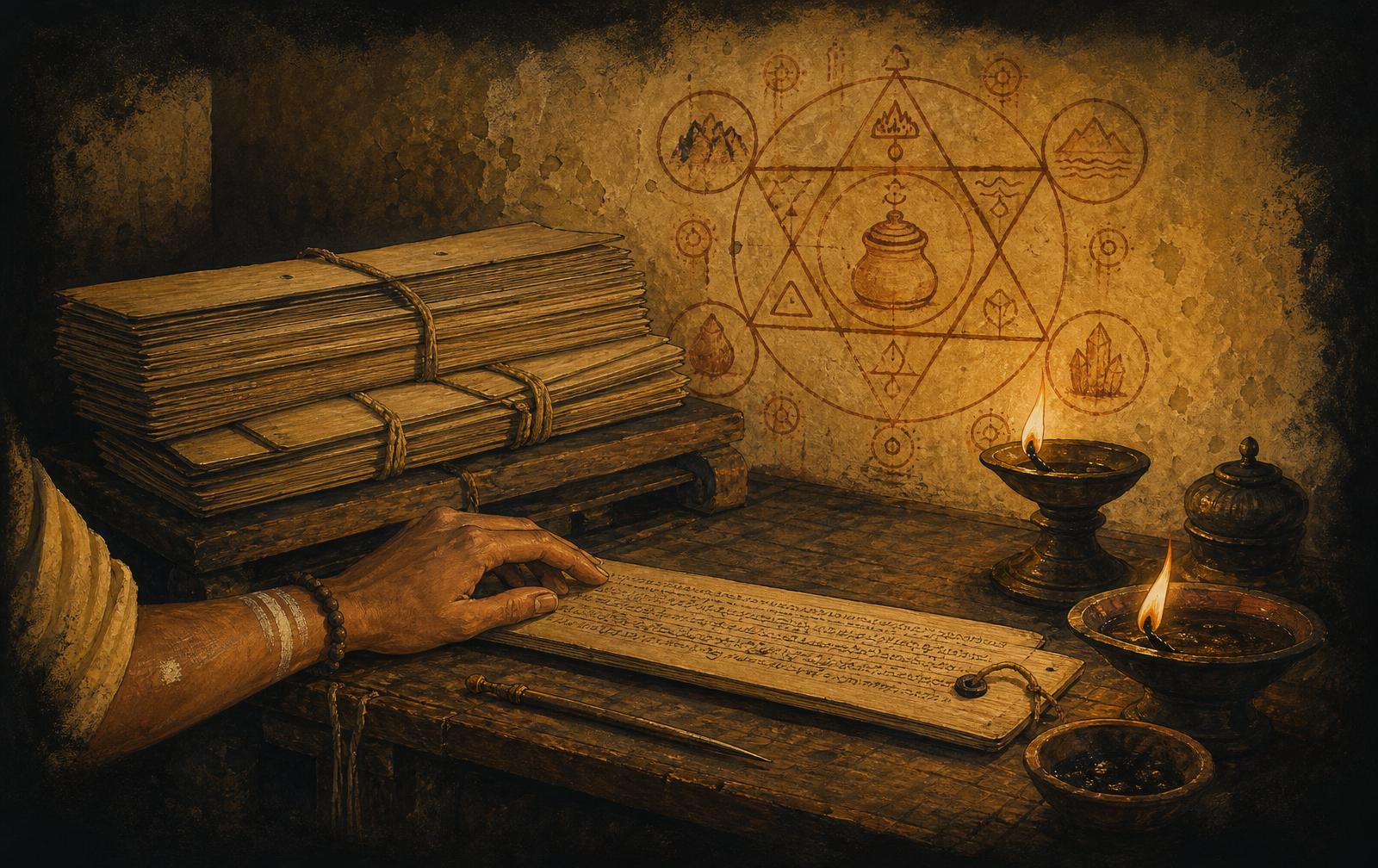
A scribe's hand steadies an ola leaf · Cittar alchemical diagram on the wall · lineage: Kalamkari · turmeric lamp
Tolkāppiyam · a grammar older than most nations
The Tolkāppiyam — the oldest surviving Tamil grammar — was composed in the last centuries BCE and copied, leaf by leaf, in unbroken transmission down to the present. It is not only a grammar. It is a description of the world: the five tiṇais, the ecological landscapes each with its flower, its bird, its emotional register, its right way of speaking. Kuriñci for the hills, mullai for the pastoral forests, marutam for the watered farmland, neytal for the coast, pālai for the drylands the drought makes.
To read the Sangam anthologies through the tiṇai grid is to see a people already thinking about their land as ecology — millennia before the word.
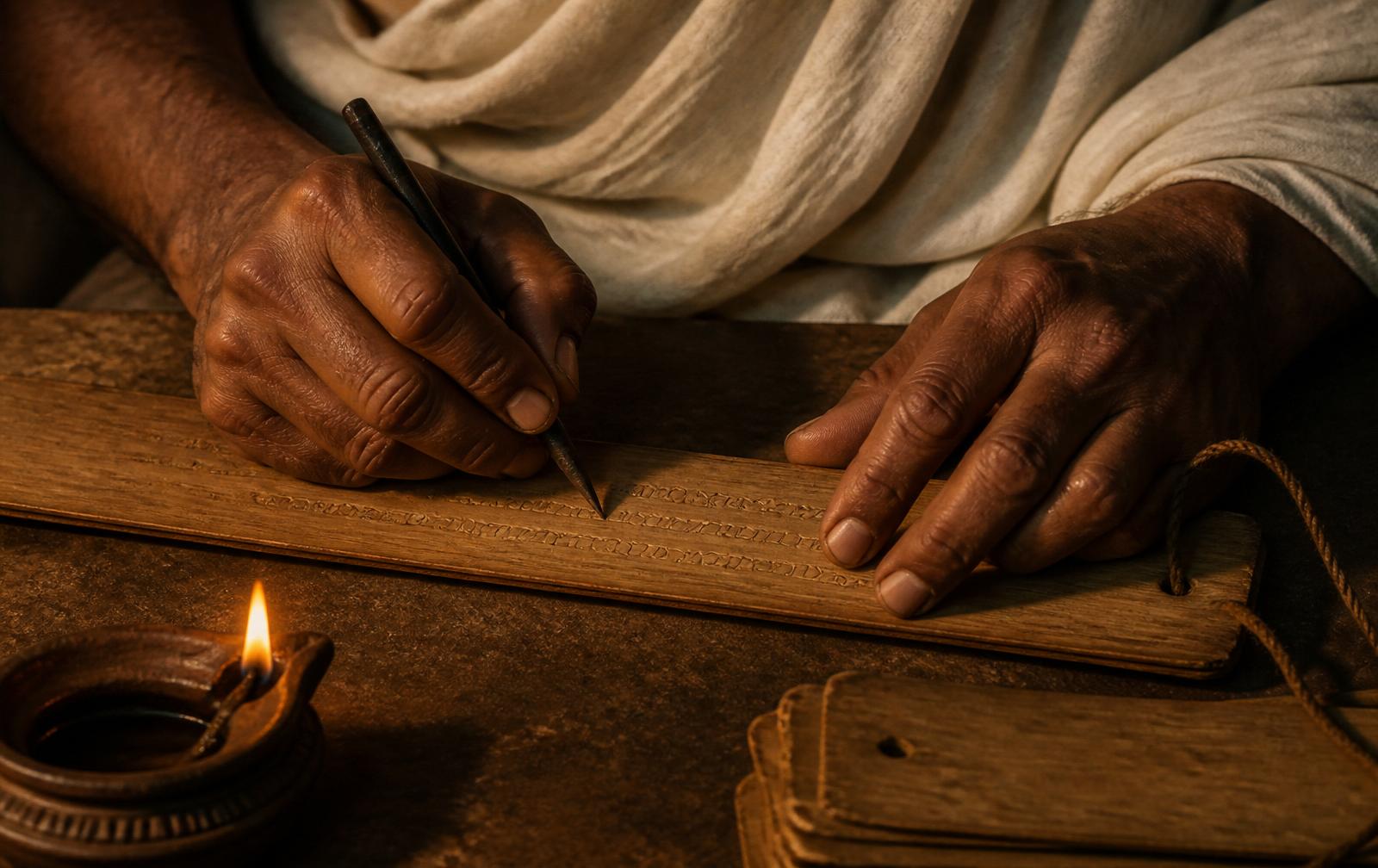
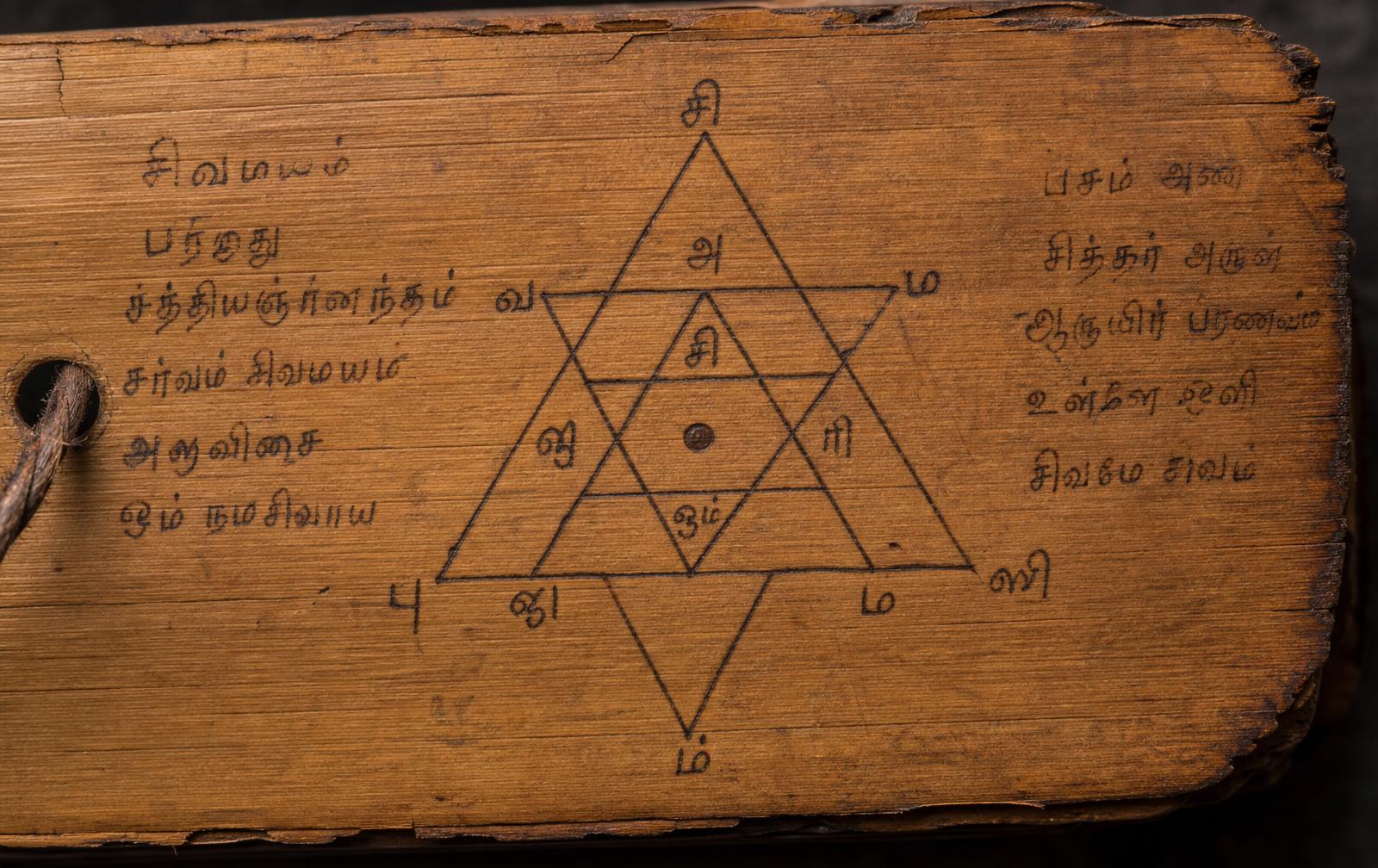
The scribe's hands · iron stylus · Sangam-era disciplineCittar yantra on ola · bindu · nine minerals · sacred geometry
The Cittar laboratory
Beside the poetry, on leaves that look identical, is another literature: the Cittar corpus. The Cittars — Tirumūlar in the Tirumantiram, then Bhoganatar, Ramadevar, Pāmpāṭṭi, Agastya — write a proto-chemistry. Muppu — a triple salt. Navapāṣāṇam — the nine minerals fused, still worshipped as the deity at Palani. Mercury purified in a dozen stages. Sulphur, arsenic, mica, tin, copper: named, classified, transformed.
This is not the periodic table. It is not pretending to be. It is a different way of arranging the same matter. Where later chapters of this archive treat Tamil Śaivism as a working epistemology, this is where the empirical evidence lives — on leaves, in the workshops of Palani and Chidambaram and Kutralam, in Tamil words that predate every other scientific vocabulary the region has now adopted.
அன்பே சிவம் — Love is Śiva. All chemistry begins in a relation.
— Tirumantiram · attributed to Tirumūlar, c. 6th–7th c. CE
Why the leaf survived
The leaf survived for three reasons, all of them worth naming. First, climate: turmeric-cured palm resists the fungal life of the tropics better than any imported substrate. Second, distributed custody: every major temple, every household of a certain class, held its own copies — there was no single library to burn. Third, ritualised copying: a scribe who mis-copied a line inherited the karmic burden of every future mis-reading. The transmission chain was disciplined by consequences a British Museum accession register does not know how to describe.
When one custody model fails — as it did, catastrophically, at Jaffna in June 1981 — the distributed floor holds. That story is Chapter VI.