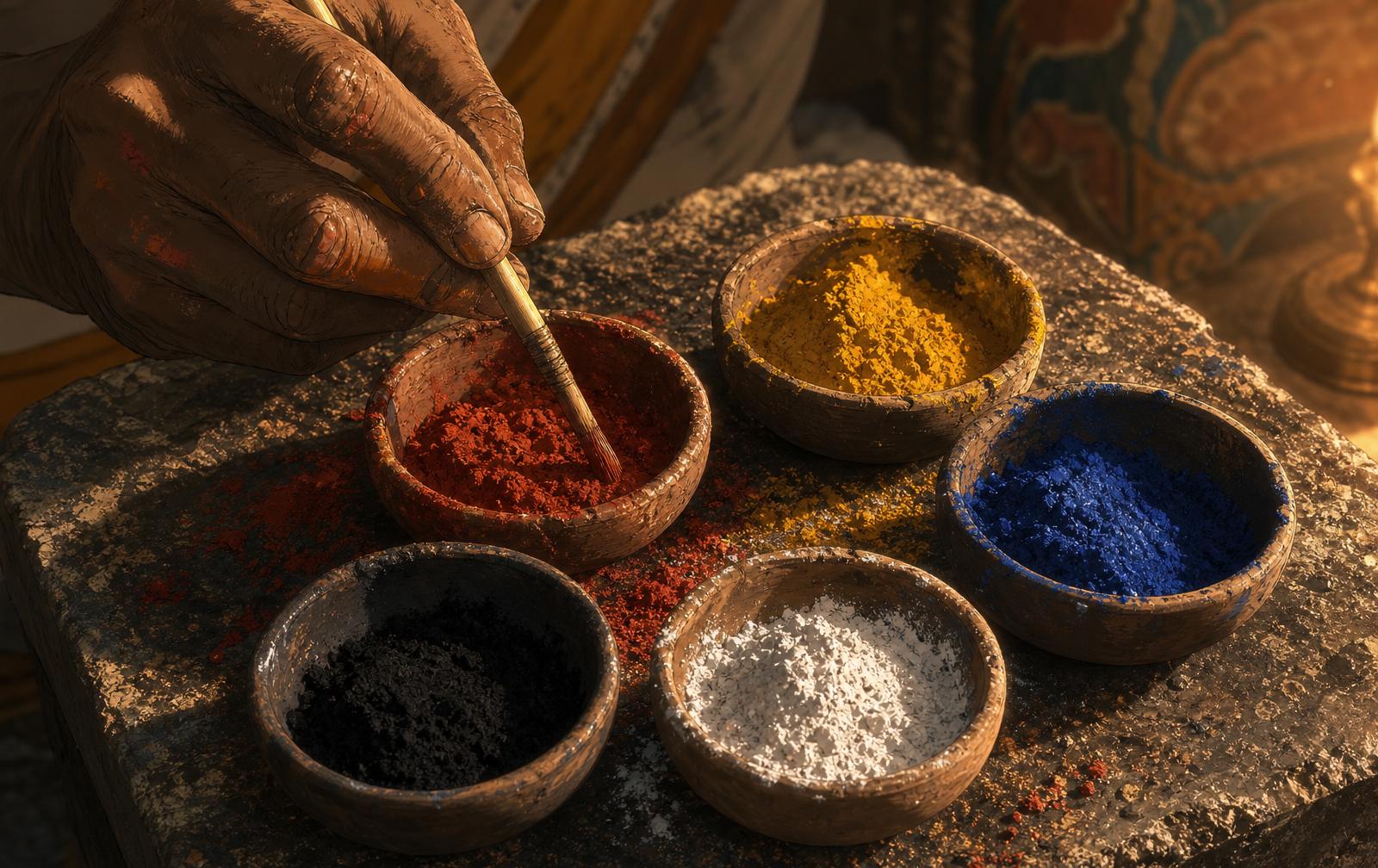
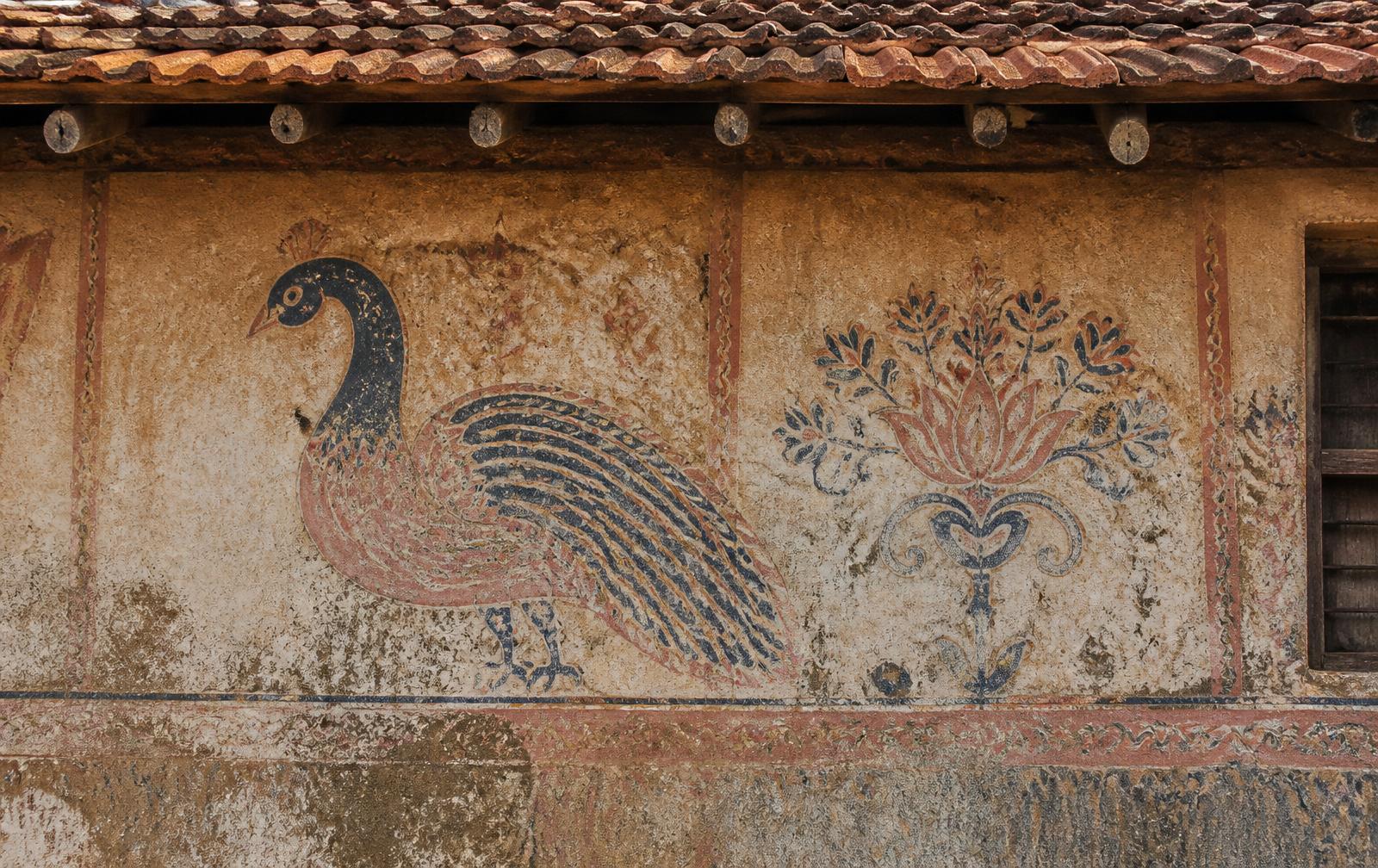
Every image in this archive is drawn out of five earths. Ochre — burnt red from iron-rich clay. Turmeric yellow. Indigo — a plant that mineralises when it dries. Lamp-black — soot from a burning oil-wick collected on a cool plate. Chalk white — lime, from crushed shell. Five mineral colours. The god of the mandapam wall, the peacock beside the god, the lotus at his feet: all of them made of these five. Nothing else.
The five earths — ochre, turmeric, indigo, lamp-black, chalk · a hand and a bamboo brush · lineage: Kerala–Tanjore–Jaffna mural craft
Three coasts, one register
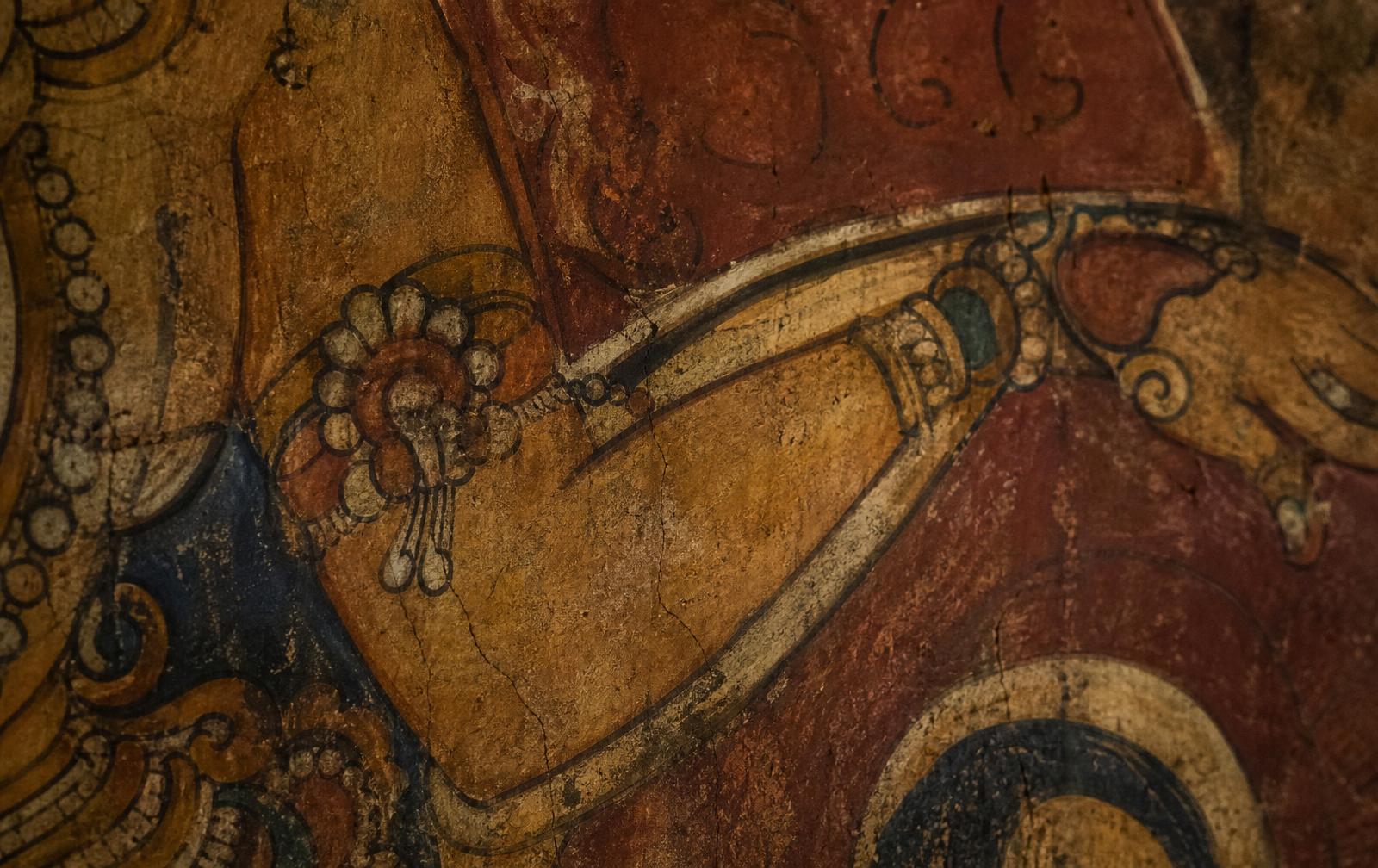
The mural tradition that produced the walls of Mattancherry Palace in Kochi, the Brihadeeswarar interior at Thanjavur, and the ceiling registers of the Nallur Kandaswamy temple at Jaffna is one continuous craft. Different patronage, different centuries, different political flags — but the same five pigments, the same lamp-black outline, the same way of setting the figure inside a decorated frame that is itself a small cosmos of vine and bird and blossom.
To call any one of these "regional" is to mis-read the water they came out of. The mural is Indian-Ocean before it is South Indian. It is Śaiva-Vaiṣṇava before it is Kerala or Tamil. And on the island, in the Jaffna and the Batticaloa and the Trincomalee mandapams, it is Tamil-Śaiva before any of the modern nation-labels found the words for what they were labelling.
Kerala temple wall · goddess fragment · five earths on plasterJaffna vernacular · peacock and kolam · terracotta eave
Five earths. Lamp-black. And a wall that has waited.
— Kerala-Tanjore-Jaffna mural craft tradition
Anime-realism, honestly declared
The images in this archive are drawn in what we openly call anime-realism — the atmospheric gravity of a Ghibli or a Shinkai frame, held in a Tamil visual lineage. They are hand-composed. They declare their pigment source in every panel: Kalamkari line, Chola bronze silhouette, Kerala mural ochre. They refuse the generic AI cinematic — purple gradients, chrome, a photorealism that flattens the drawing. They refuse the named face. They refuse the placeless landscape. Every image says which coast it is standing on.
This is not decoration and it is not aesthetic preference. It is jurisdiction. A picture that says nothing about where it comes from can be conscripted into any argument. A picture that names its five earths cannot.
What this layer holds
When later chapters of the archive treat the temple as an instrument, the mural is where the instrument tunes its colour. When iconography is treated as a civilisational grammar, this is the syllabary. Five earths. One lamp-black line. A wall that has waited.