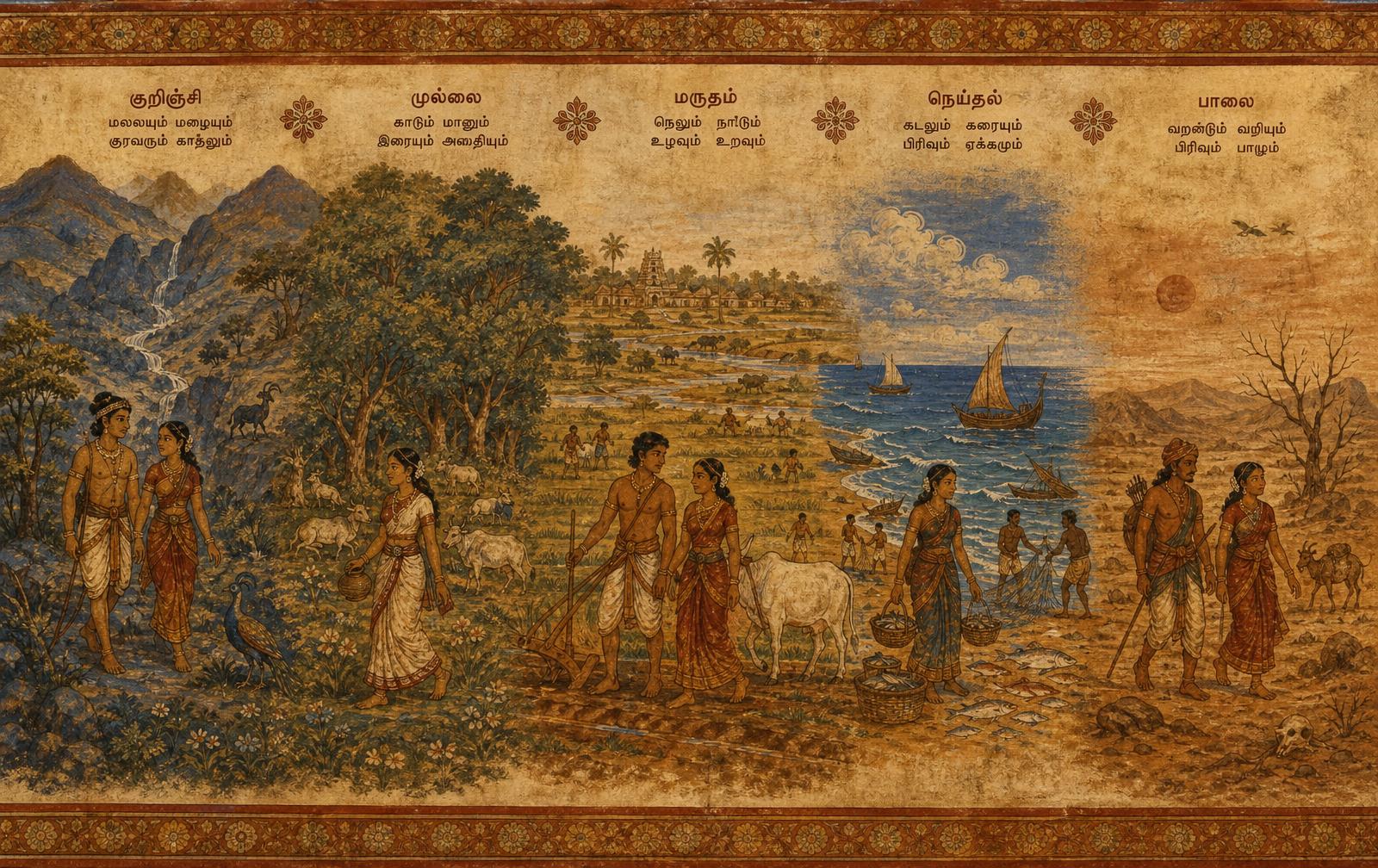
The Sangam is two things at once, and the Tamil word does not separate them. It is an assembly — a council of poets, three of them across a mythic-historical arc, meeting under Pandyan patronage to certify what was worth keeping. And it is a confluence — a place where waters gather. The corpus that survives is the second Sangam and the third, twenty-six-hundred poems that read like a river system.
The five landscapes · kurinji · mullai · marutam · neital · pālai · lineage: Chola mural composite
The five landscapes · aintiṇai
The Tolkāppiyam gives every Sangam poem a landscape. Not as setting — as ontology. To place a poem in kuriñci (the hills) is to say that its people are hunters, its flower is the strobilanthes, its season is the cool months, its emotional register is the sudden meeting of lovers. To place a poem in pālai (the drylands) is to say its register is separation, its animals are the vulture and the black snake, its trees are the neem gone to stick, its central emotion is the endurance of what cannot be helped.
Kurinji · mullai · marutam · neital · pālai. Hill · forest · farm · coast · drought. Five landscapes and their inward equivalents in one grammar. No European poetic tradition had a system like this at the same date. Most still don't.
யாதும் ஊரே யாவரும் கேளிர் — every town is our own, every one is kin.
— Kaṇiyaṉ Pūṅkuṉṟaṉār, Puṟanāṉūṟu 192
Poetry as ecological memory
A Sangam anthology is a map that has forgotten it is a map. The Kuṟuntokai is short love-lyrics. The Akanāṉūṟu is the longer interior-life corpus. The Puṟanāṉūṟu is the outward-life corpus — kings, patronage, battle-honour, the ethical weight of a gift. Read together, they name a coastline, a rainfall regime, a set of village crafts, a bird calendar, a herbal pharmacopoeia. They pre-record the ecology the tinai grammar then classifies.
When the archive later invokes an Indian-Ocean Tamil ecumene — when it asks the Palk Strait to be read as a shared house and not a border — this is the pre-vocabulary. The Sangam poets did not need to argue for the coast because they were already in it.
What the Sangam does not do
It does not name a nation. It names patrons and rivers. It does not police a religion. It knows Śaiva, Vaiṣṇava, Jaina, Buddhist patrons and gives each their register. It does not centralise authority. Three Sangams, then the survivors of the third, then commentators, then scribes — knowledge distributed across an intelligentsia the way palm leaves are distributed across a temple.
It is a civilisational stance that later chapters of the archive keep having to re-explain to modern states: that a language, a land, and a practice can be a coherent civilisation without becoming a nation, and that this is not a lack.
What this layer holds
The Sangam gives the archive its tone. When the Chronicle writes with restraint, when the Case Organ refuses to inflate a claim, when Magalir Avai names harm without naming a survivor — that discipline traces to a poetic tradition that already knew a landscape was not a possession, and a kinship was not a border.