Chapter VI of VI · a ground-wound, not an indictment
நூலகம்
nūlakam · the library · the place-of-threads
Nūlakam. The Tamil word for library holds the word for thread inside it — nūl. A library is a place where threads are kept. The Jaffna Public Library, on the night of 31 May and the first day of June 1981, lost roughly ninety-seven thousand of them.
This chapter is not the accountability chapter. That work belongs to the Case Organ, the Unmai desks, the cited Tier-A record. This chapter is the ground-wound — the layer beneath the accountability, where the question is not "who set the match" but "what did the fire touch, and what did the ground already know that the fire could not reach."
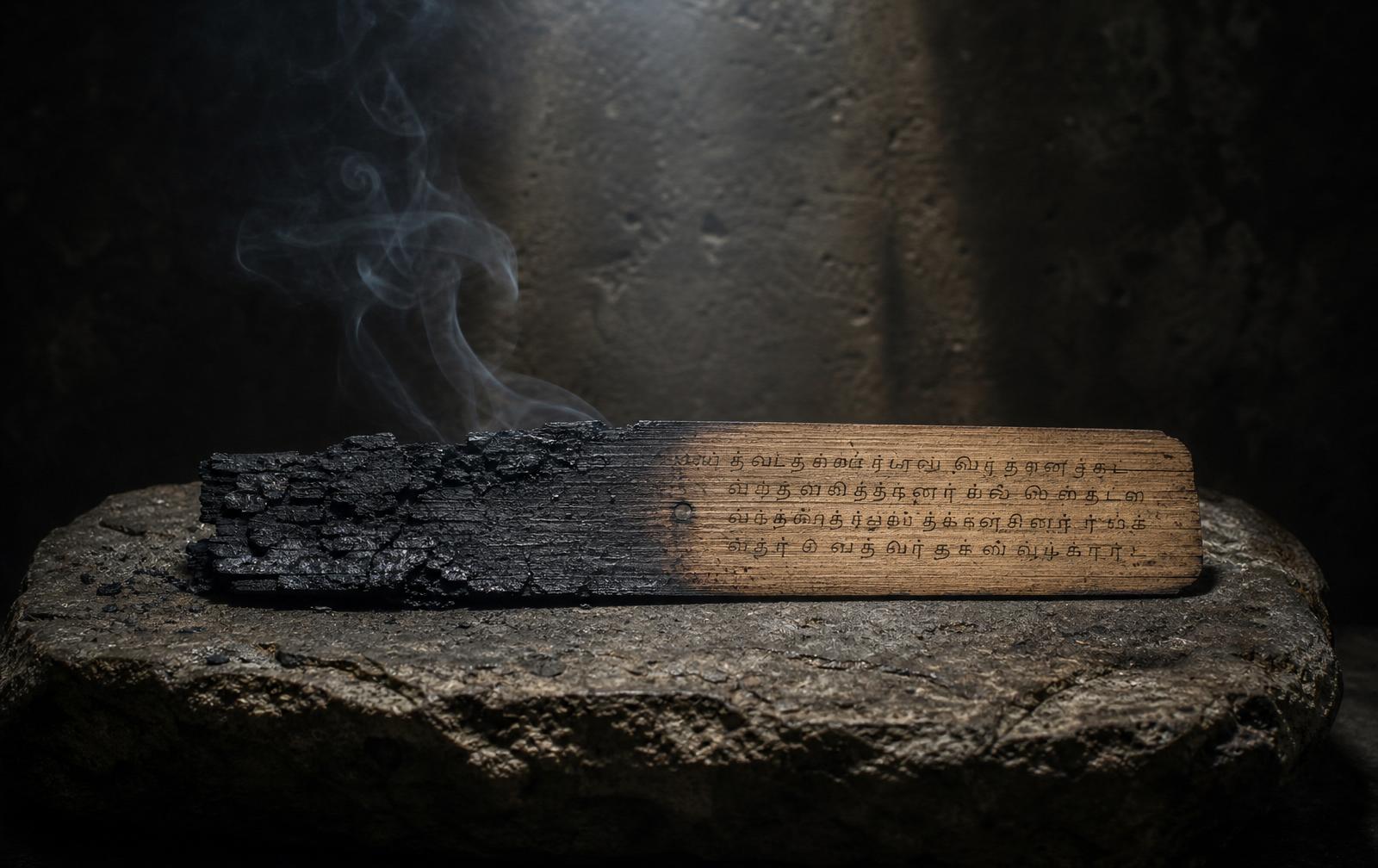
A half-burned palm-leaf on stone · Tamil script still legible on the unburnt half · lineage: elegy pigment
What was in the room
Ninety-seven thousand volumes, in the standard count. A copy of the Yalpana Vaipava Malai. The complete Ramanathan collection. Palm-leaf manuscripts inherited from households across the peninsula — Cittar treatises, Śaiva Siddhānta commentaries, medical vaidya ola, temple sthala-purāṇain the Nallur, Naguleswaram, Keerimalai registers. Ephemera: pamphlets from the 1930s, cinema magazines, the paper trail of a north-eastern intellectual life the twentieth century had built.
A specific density of one civilisation's writing about itself, gathered in one two-storey building on Colombogam Road. Because it had been gathered in one building, the fire found it in one building. Chapter III — The Palm-Leaf — argued that the leaf survived because custody was distributed. The Library shows what happens when a modern century, for good reasons, centralises what an older century had wisely spread.
What burned was not only the books. What burned was the room in which the books had learned to be next to each other.
— On the loss · Jaffna civil elders, oral testimony gathered by the Public Library reconstruction committee
Two layers · Aarambam / Nilaiththanmai
Now · Aarambam
The building was rebuilt. The rebuilt hall is beautiful; the rebuilt collection is small. Digitisation has been ad-hoc, mostly donor-funded, and centred on what was famous rather than what was quiet. Diaspora households across London, Toronto, Zürich, Sydney, Chennai hold the orphaned ola of the burned catalogue — some in temperature-controlled storage, most in a cardboard box on top of a wardrobe.
Becoming · Nilaiththanmai
A diaspora library-of-record is not a building. It is a distributed floor, in the pattern the palm-leaf tradition already knew: every household of a certain class holds its own copies; every copy is catalogued to a shared index; the index survives even if any single custodian does not. The technical layer is trivial — an open-schema manuscript register, checksum-verified scans, a public finding-aid. The civilisational layer is the harder ask: that every Tamil household in the diaspora that holds a piece of the burned room understands itself as a temporary custodian, not an owner.
This is the shape the archive is trying to hold open. Aazham is the ground beneath the building. The building will burn again — buildings always do. The ground is the point.
What this layer holds
The Library is the chapter where Aazham stops being a passive ground and asks something of the reader. If you are of the diaspora and there is an ola in your family, this chapter is asking you to notice it before it goes back into the box. If you are not of the diaspora, this chapter is asking you to understand that the room on Colombogam Road was not a Tamil provincial library; it was one of the last physically-concentrated instances of a very old civilisational intelligence, and its loss is not local.