A civilisation can be measured by what it makes and by whether it can keep making it. On both counts the Tamil south passes a test very few societies in world history pass: it has been casting figurative bronze in the same lost-wax lineage, in the same handful of villages, for more than a thousand years. The technique did not survive despite the intervening centuries. It survived because of them.
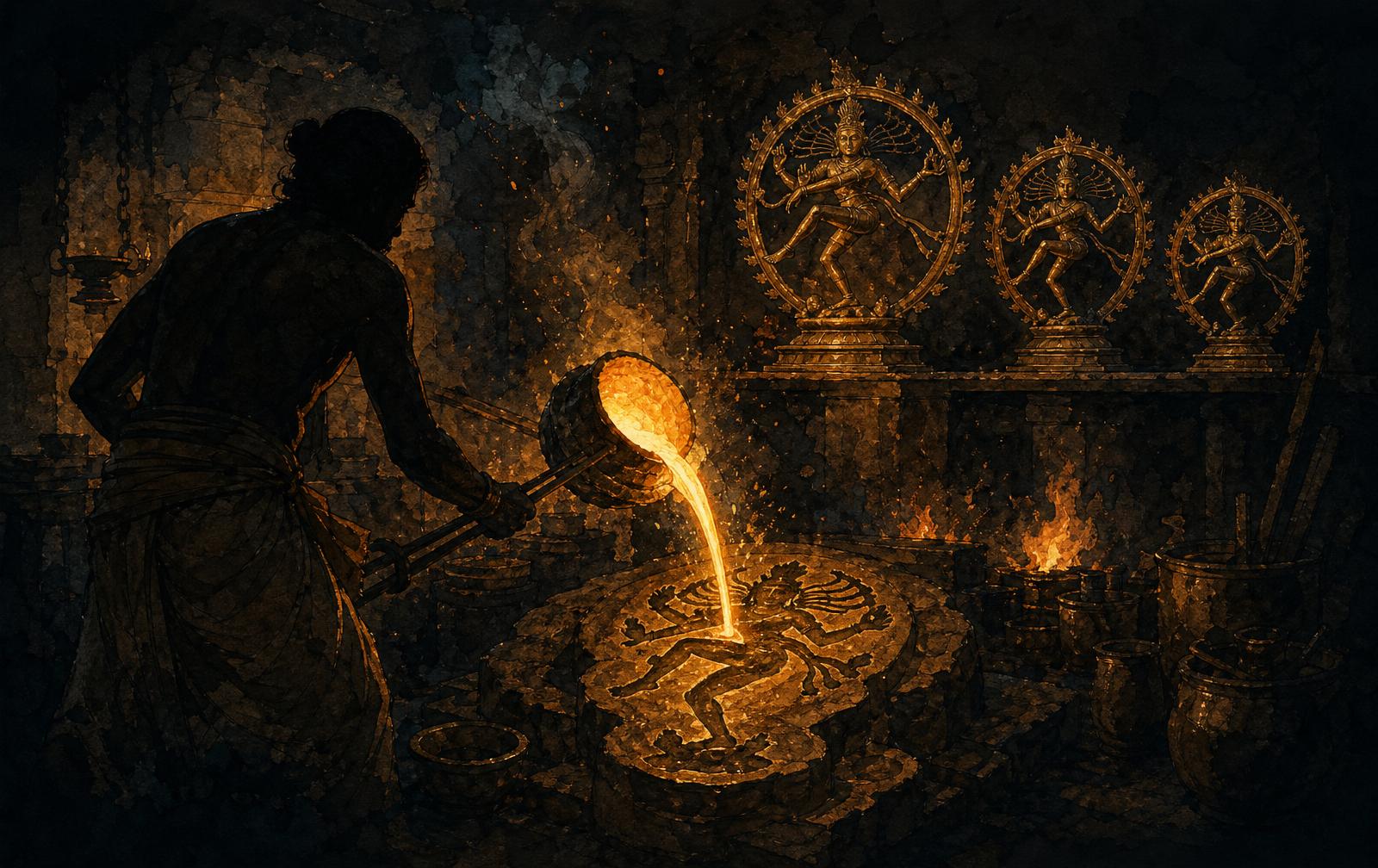
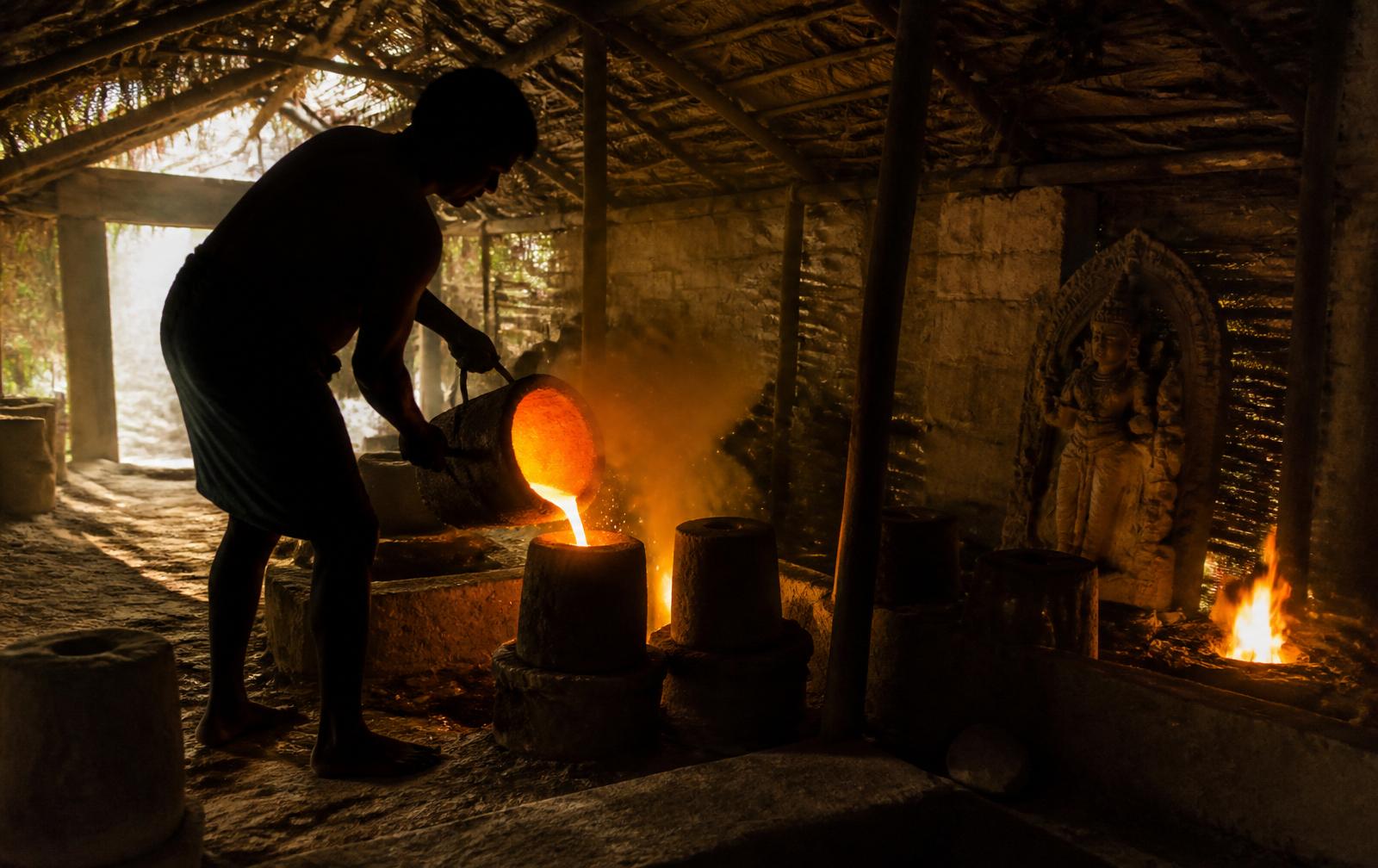
A foundry pours bronze into a Nataraja mould · lineage: Chola foundry · lost-wax · lamp-black
Lost-wax · the technology of remembering
A wax figure is sculpted at full size. It is coated in successive layers of fine river clay, then coarser, then coarser still, until it is a rough egg around a hidden god. The egg is fired. The wax runs out. Molten bronze — copper, tin, in the classical Chola alloy a whisper of lead and zinc — is poured into the void. When the metal cools, the clay is broken open. The mould is destroyed in the same act that reveals the figure. There is no edition. There is no master. Each bronze is a singular event.
The Chola atelier at Tanjore (10th–13th century CE) turned this technique into the finest figurative metallurgy of its age anywhere on Earth. What survives — the Nataraja from Tiruvarangulam, the Śiva-Somāskanda groups now scattered across five continents of museums — is a fraction of what was made. What was made is a fraction of what was possible.
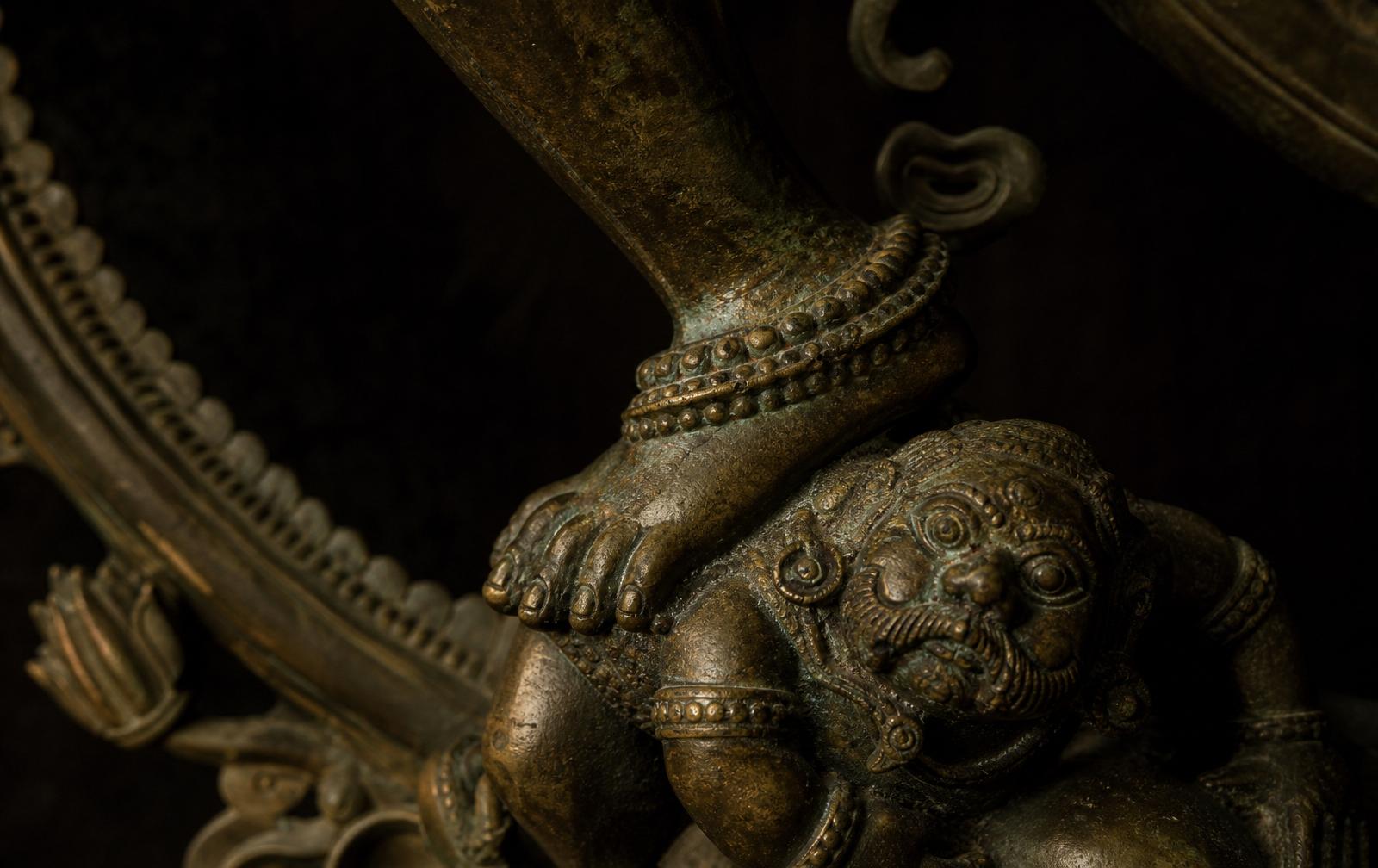
The pour · Swamimalai lineage · clay-encased mould · single eventNataraja · foot on Apasmara · forgetting held down
Nataraja · a diagram of the world in metal
The Chola Nataraja is not a portrait of a god dancing. It is a diagram. The five acts — creation, preservation, dissolution, concealment, grace — are each assigned a hand, a foot, or a ring. The prabhāmaṇḍala, the fire-halo, is the cosmos. The dwarf trampled underfoot is apasmāra, forgetting. The raised right hand is the drum whose strike is time beginning again.
Padma Kaimal's 1999 essay Shiva Nataraja: Shifting Meanings of an Iconshows that this diagram is Tamil-Śaiva before it is pan-Indian. The Nataraja arrives in the North Indian imagination centuries later, through Chola conquest and Chola exports. The icon walked the world from here.
The Nataraja icon, in the form that has become world-famous, is a Chola Tamil composition. Its later pan-Indian meaning is a downstream event.
— Padma Kaimal, The Art Bulletin, 1999
The village that never stopped
In Swamimalai, in the Kaveri delta, families of sthapatis — hereditary bronze-casters — are still working the Chola alloy in courtyards a few metres from where their great-great-great-great-grandfathers worked it. GI-protected since 2008. The wax is bees'-wax cut with tree-resin. The clay is river clay from a specific bend. The gods, when the clay is broken, come out the way they came out in the tenth century.
What this layer holds
When later chapters of the archive argue that Tamil Śaiva civilisation on the island — at Tirukoṇēśvaram and the Pañca Īśvarams — is not a colonial invention but a continuous material practice, this is the ground they stand on. The bronze is older than the argument. The bronze cannot be legislated away.