நடராஜா
The Grammar
Five acts on one body, read as a diagram of institutional behaviour. Analogy, never identity.
7 sections · 30 pages in the print edition
II.0
A warning before the reading
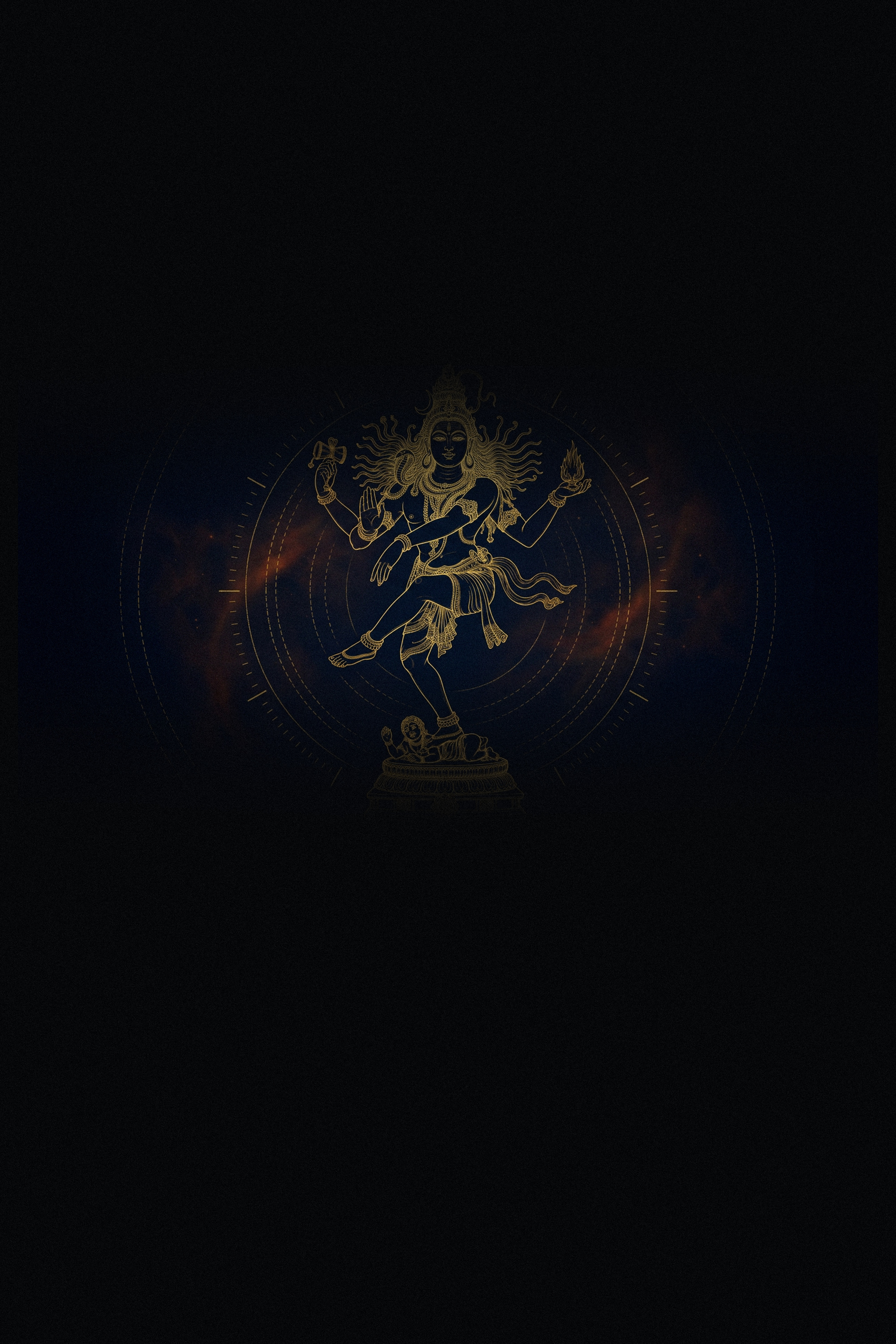
What follows reads a bronze as a diagram. It is not theology, and it is not physics. The distinction is not decorative — collapse it and the whole part becomes indefensible.
How this part must not be read
- Not as a religious claim. The image is devotional to millions; this reading has no standing over that meaning and does not compete with it.
- Not as physics. The correspondence between a dancing figure and particle behaviour is a twentieth-century literary conceit, not a result.
- Not as identity. The body does not claim to be the figure. It borrows a grammar.
- Not as a mandate. No sacred image authorises any political act in this volume.
What is taken is narrow and structural: the figure performs five distinct functions simultaneously on one body, and a stateless institution needs precisely that — a way to be several things at once without becoming incoherent.
II.1
பஞ்சகிருத்தியம்
Pancakritya as civic grammar
The classical reading assigns five acts to the figure: creation, preservation, dissolution, concealment, and release. This volume renders them as five verbs an institution performs, and holds itself to all five at once.
- Strikeபடைத்தல்
- Make things appear. Publish. The archive's first duty is that a record exists at all, and exists where it can be found.
- Holdகாத்தல்
- Maintain continuity. A published record that cannot be retrieved in a decade was never published; it was announced.
- Releaseஅழித்தல்
- Let go without scattering. Retire what is superseded, in public, with the reason recorded. Dissolution is a governed act, not an accident.
- Pressமறைத்தல்
- Hold down forgetting. Not concealment of truth — the suppression of the force that erases. The demon under the foot is amnesia, and it is pressed, not killed.
- Liftஅருளல்
- Leave the door open. The raised foot is the standing offer of return, to a reader, a critic, an institution, or an opponent who changes position.
Most organisations manage two or three. A campaign strikes and cannot hold. A library holds and never strikes. A bureaucracy presses and never lifts. The grammar is a demand that all five be performed on one body, permanently, and it is used in this volume as an audit instrument: any organ failing one of the five is failing.
II.2
Contained fire
The figure holds fire in an open hand, within a ring of fire that closes the composition. The flame is not thrown. It is also not hidden — it is presented, upward, in full view.
This is the single most important constraint in the volume, and it is an engineering constraint before it is an ethical one. Energy that is contained remains available. Energy that is discharged is gone, and the discharge is the moment the containing body loses its standing.
Applied: this body documents rather than accuses, cites rather than concludes, publishes rather than campaigns, and refuses every capability that would require the flame to leave the palm. Not because grievance is unwarranted — because a body that discharges once is thereafter read as a combatant, and a combatant's archive is evidence of motive rather than evidence of fact.
கையில் நெருப்பு. வீசப்படுவதில்லை.
Fire in the hand. Never thrown.
Now · Aarambam
Containment is enforced by published refusals, by desk-level rules, and by a review step before anything is published.
Becoming · Nilaiththanmai
Containment is structural — no organ possesses a capability that could be discharged, so restraint is not required of anyone's judgement.
II.3
முயலகன்
Muyalaka as the archive

Beneath one foot lies a small figure, pressed but intact. Read here as forgetting — the ordinary, continuous, unmalicious force by which a record decays into rumour and rumour into nothing.
Note what is not depicted. It is not killed. There is no version of this iconography in which the figure is absent, because the pressure is permanent and the pressing is the work. An archive is not a project that completes. It is a foot that stays down.
This is why the volume prints no completion date, no roadmap, and no target state that could be reached and celebrated. The moment an archive declares itself finished, the foot lifts.
The reading is analogical and internal to this volume. It carries no interpretive authority over the iconographic literature.
II.4
The raised foot
The other foot is lifted. In the devotional reading it is refuge. In this volume it is the door the body refuses to close: on the critic, on the sceptical institution, on the researcher who arrives hostile, and on anyone from any community who wishes to check the record.
Holding a door open has a cost, and the cost is that hostile readers get in. This volume accepts that cost explicitly. Every claim is printed with its authority precisely so that a hostile reader can check it, because the only durable form of credibility is the kind that survives someone actively trying to break it.
The door does not close on
- Researchers whose conclusions oppose this body's framing.
- Institutions that have previously refused engagement.
- Members of any community named anywhere in the archive.
- Critics who publish against the archive using the archive's own citations.
II.5
The grammar as an audit instrument
| Act | The question asked of every organ | Failure signature |
|---|---|---|
| Strike | Did anything get published this era? | Activity without artefacts. |
| Hold | Is what was published still retrievable? | Dead links, moved files, lost provenance. |
| Release | Was anything superseded retired in public? | Silent deletion, quiet edits. |
| Press | Is decay actively resisted, or only noticed? | An archive that grows but is never re-verified. |
| Lift | Can a hostile reader enter and check? | Gated evidence, unpublished method. |
The grid is run against every organ in Part III. It is the cheapest governance instrument in the volume: five questions, no metrics, no dashboard, answerable by anyone holding the book.
II.6
Precedent and limits
Reading an inherited image as an institutional diagram is not novel. Legal and political traditions across the world have taken scales, columns, thrones and rings as compressed statements of how power should behave. The move is legitimate as long as it stays a reading and does not become a warrant.
The limit is strict. Nothing in this part authorises an action. If a proposed act can only be justified by the grammar and not by the Charter, the citations, and the law of the jurisdiction, it is not performed.
A diagram may describe an institution. It may never excuse one.
8 parts · Era Aarambam · Aarambam edition · authored in English