தீ நூல்
Tī Nūl
The Fire-Book
Transformative League of Tamil Eelam
தமிழீழ மாற்றுருவாக்க அவை
AARAMBAM EDITION · FIRST DEPOSIT · VOLUME I
தீ நூல்
Tī Nūl

தீ நூல்
The Fire-Book
The Charter, Architecture and Method of a Stateless Civilisational Body
Transformative League of Tamil Eelam
Era · Aarambam
This volume is issued by a stateless civilisational body. It is not a company report, a party programme, a charity appeal, or a claim of government. It describes an architecture and the rules that bind it.
This volume refuses to speak for anyone who has not consented to be spoken for. It names no survivor, aggregates no atrocity counts, and issues no verdict. Where a claim is load-bearing, its source is named on the same spread.
Copies are placed with legal deposit libraries in the United Kingdom under the Legal Deposit Libraries Act 2003, so that the record survives the body that made it. Where the deposited paper and the digital edition differ, the deposited paper governs.
Reproduction for scholarship, submission, parliamentary use, and legal record is permitted with attribution. Reproduction that alters a refusal clause is not permitted in any circumstance.
AARAMBAM EDITION · FIRST DEPOSIT · VOLUME IIssued in the United Kingdomdocs.tlte.cloudTrim · 148 × 210 mmநெருப்பால் எழுதப்பட்டது. காற்றால் எடுத்துச் செல்லப்படும்.
Written with fire. Carried by wind.
- 0வாசல்The Door·
- Iஆழம்The Long Ground·
- IIநடராஜாThe Grammar·
- IIIஉறுப்புகள்The Organs·
- IVகருவிகள்The Instruments·
- Vசெயல்பாடுThe Operation·
- VIகோடெக்ஸ்The Codices·
- VIIபதிவேடுThe Register·
இரு அடுக்கு
On the two layers
Every operational statement in this volume is set twice. Now · Aarambam records what is actually running in the founding era, with nothing added. Becoming · Nilaiththanmai records the civilisational target the architecture is built toward.
The two are never merged. A reader who takes a Becoming line as a present capability has misread the page, and the volume is written so that this misreading is difficult. Where only one layer is given, the other is not yet safe to state.
காலக் குறி
On era markers
This volume keeps no calendar dates. Time is marked by era: Aarambam, the founding; Nilaiththanmai, the durable state; Nilaiyam, the seated condition. An era marker appears on every leaf.
The reason is plain. Calendar dates invite a reader to measure an institution against a promised schedule. Eras measure an institution against its own conditions of graduation, which are published and can be checked.
Part 0
வாசல்
The Door
The Declaration, the operating law of the volume, and the refusals that make the rest of it readable.
அறிவிப்பு
Declaration of the Hybrid Nation
There is a people whose ground was drawn over, whose record was burned, and whose name is carried in more passports than one. This volume does not ask for a country. It states what already exists.
The Hybrid Nation is a civilisational body without territory, without an army, without taxation, and without a claim against any state. It is additive, never substitutive. It adds a layer of memory, method and structured refusal to the lives of people who already hold citizenship elsewhere.
It holds no sovereignty. It administers no land. It commands no force. What it operates is documentation and accountability infrastructure, under the law of the jurisdiction in which it is incorporated, bound by a published Charter, and answerable to a register anyone may inspect.
This is not a lesser thing than a state. It is a different instrument, built for a condition states were never designed to address: a nation distributed across a dozen legal systems, whose continuity depends not on borders but on whether the record survives.
நெருப்பால் எழுதப்பட்டது. காற்றால் எடுத்துச் செல்லப்படும்.
Written with fire. Carried by wind.
இரு அடுக்கு
The Two-Layer Rule
The operating law of this volume. Every page after this one obeys it.
Institutions fail in one of two directions. They describe what they have and never state what they are for, and so they drift. Or they describe what they intend and pass it off as what they hold, and so they lie. This volume refuses both by printing two layers on every claim.
- Nowஆரம்பம் · Aarambam
- What is operationally true at the time of this edition. Live, inspectable, falsifiable. If it cannot be checked today, it does not belong in this layer.
- Becomingநிலைத்தன்மை · Nilaiththanmai
- The civilisational target the same category points toward. Never dated. Never promised. Stated so the reader can measure the distance and hold the body to it.
The distance between the layers is not an embarrassment to be minimised. It is the most honest measurement in the volume. A body that shows no gap is either finished or lying, and nothing in this era is finished.
The Two-Layer Rule is applied by hand, by the authors, and enforced in review. A claim printed without both layers is a defect and is corrected in the next edition.
The rule is machine-checkable: no page publishes to any surface without both layers resolved, and the changelog records every correction.
மறுப்புகள்
The Refusals Preface
What this body has declined to become, and why the declining is the argument.
Anyone can publish grievance. Grievance is cheap, abundant, and — after seventy years — almost entirely discounted by the institutions that would need to act on it. What is scarce is a body that publishes the powers it has refused to take.
Every refusal in this volume is load-bearing. Each one closes a door that would have made the work easier and the body less defensible. Together they form the only real evidence that this is a standards instrument and not a campaign with better typography.
- No claim of sovereignty, territory, taxation, or citizenship against any state.
- No armed capability, no security function, no protective service of any kind.
- No naming of perpetrators, serving personnel, survivors, or families. Naming belongs to the bodies with a mandate for it.
- No aggregated counts of atrocity produced in-house. Cite the authority that holds the count.
- No direct survivor intake on any surface. Route to the organisations equipped to receive it.
- No verdicts, no forecasts, no scores, no risk maps.
- No glorification of any proscribed organisation.
- No covert operation, no clandestine unit, no intelligence function that cannot be published.
- No calendar dates, no roadmap, no promised feature.
- No donation appeal, no pricing, no call to action inside this volume.
Every refusal is repeated at the point of use, in the part where the temptation to break it is strongest. The complete index is printed in Part VII.
How to read this volume
- 01Parts are self-contained. Any part may be read first. Nothing depends on sequence except the Register, which depends on everything.
- 02Three visual registers run through the book. Warm full-bleed plates carry the long ground and the grammar. Cold hairline diagrams carry the architecture and the method. Prose pages carry no image at all. When a page changes register, the argument has changed register too.
- 03Icons mark state. A filled icon is operational now. An outline icon is becoming.
- 04Every load-bearing claim carries a gloss naming its authority. A claim without a gloss is the body's own statement about itself and should be read as such.
- 05Blank pages are intentional. They are the only place in the volume where nothing is being asserted.
Part I
ஆழம்
The Long Ground
A node existed before the state was drawn. The node did not stop existing when the drawing happened.

Why depth comes first
Every argument about this people begins in 1948, or 1956, or 1983, or 2009. Beginning there concedes the premise: that the community is a post-colonial minority problem, and that the frame of reference is the state that inherited the island.
The long ground refuses that framing without denying a single fact inside it. It establishes something prior and materially demonstrable — that the northern and eastern littoral of this island functioned as a node in an Indian Ocean exchange system for a very long time, and that the node's economy, script, metallurgy and ritual grammar were continuous with a wider Tamil-speaking world across the strait.
This is not a claim to ownership. Antiquity confers no title, and this volume makes no title claim. It is a claim about legibility. A community read as a minority inside a young state is legible only as a problem to be managed. The same community read as a node in a maritime system is legible as a civilisation with its own record, its own methods, and its own standing to keep them.
கடல் எல்லை அல்ல. கடல் வழி.
The sea is not a border. The sea is a road.
பருவக்காற்று
The Monsoon Economy
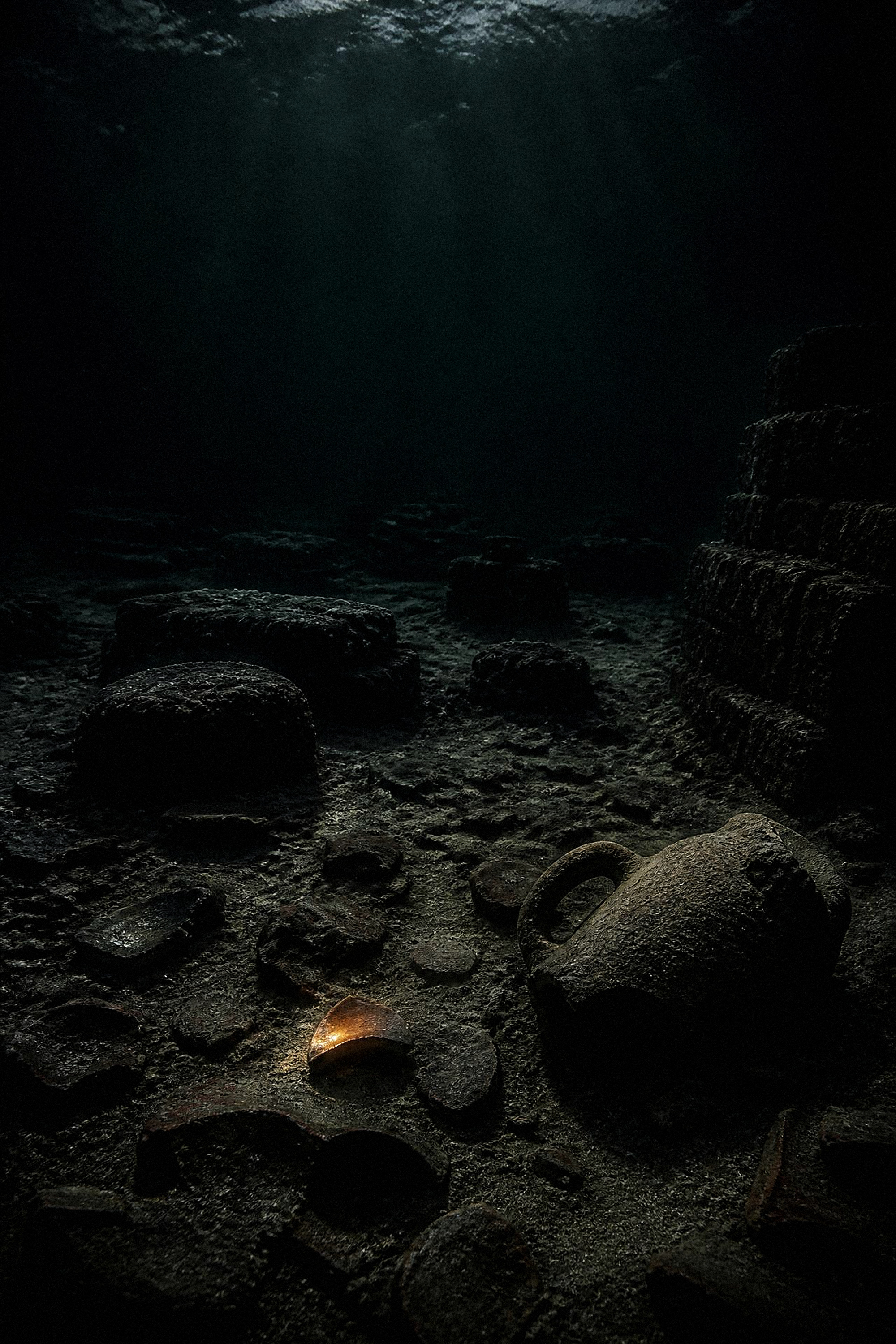
Before engines, the Indian Ocean ran on a clock. The south-west monsoon carried vessels one way for a season; the north-east carried them back. Trade was not opportunistic — it was scheduled by weather with a reliability that road networks of the same period could not match.
A settlement positioned on that clock is not peripheral to anything. It is a station. Ports on the Palk and Mannar coasts sat where the seasonal reversal made landfall necessary, and the resulting pattern of exchange left material traces — ceramics, coin, beads, iron — that do not originate locally and cannot be explained by internal trade.
The consequence for this volume is structural rather than sentimental. A maritime station is oriented outward by default. Its natural counterparties are other stations, not its own hinterland. That orientation is the oldest continuity in this record, and it is the same orientation the diaspora reconstituted, unintentionally, after displacement.
Monsoon-scheduled Indian Ocean exchange is standard in the maritime archaeology and economic history literature; this volume asserts no dating beyond the peer-reviewed consensus and names no site as exclusive to any community.
Kantarodai and the material floor

There is an early urban horizon on the northern peninsula. It carries coinage, imported ceramics, ritual architecture, and evidence of craft specialisation. It is a settled, layered, commercially connected place, and it predates every political arrangement now argued about.
This volume takes exactly one thing from that horizon: the fact of depth. It does not assign the site to an ethnicity, does not use it to date any community's arrival, and does not enter the arrival-priority argument at all. That argument is a trap for everyone in it, because it accepts that the older presence wins and therefore guarantees a permanent contest over what 'older' means.
- No arrival-priority claim. This volume never argues that one community was here first.
- No assignment of an archaeological site to an ethnic group.
- No dating beyond published, peer-reviewed consensus.
- No use of antiquity as a title claim over any land.
ஓலைச் சுவடி
Palm-leaf transmission
The palm-leaf manuscript is the most instructive object in this part, because it solves the same problem this volume solves, with different materials.
A palm leaf is organic. It degrades. In a monsoon climate it has a working life measured in generations, not centuries. The tradition survived not by making the object permanent but by making copying obligatory. Continuity was procedural: the text lived because a scribe was required to reproduce it before the leaf failed.
That is a continuity architecture, and it is the one this body has adopted. No single copy of the record is treated as safe. Survival is a function of replication across custodians who do not share a single point of failure — not of any vault, any server, any company, or any person.
The canon exists as a public web archive, a print edition, deposited copies in national libraries, and a content-hashed source bundle. Four media, different failure modes.
Replication is routine and distributed across custodial institutions in multiple jurisdictions, with the copying obligation written into the Charter rather than depending on the attention of any individual.
The leaf was never meant to last. The copying was.
வெண்கலம்
The bronze workshop
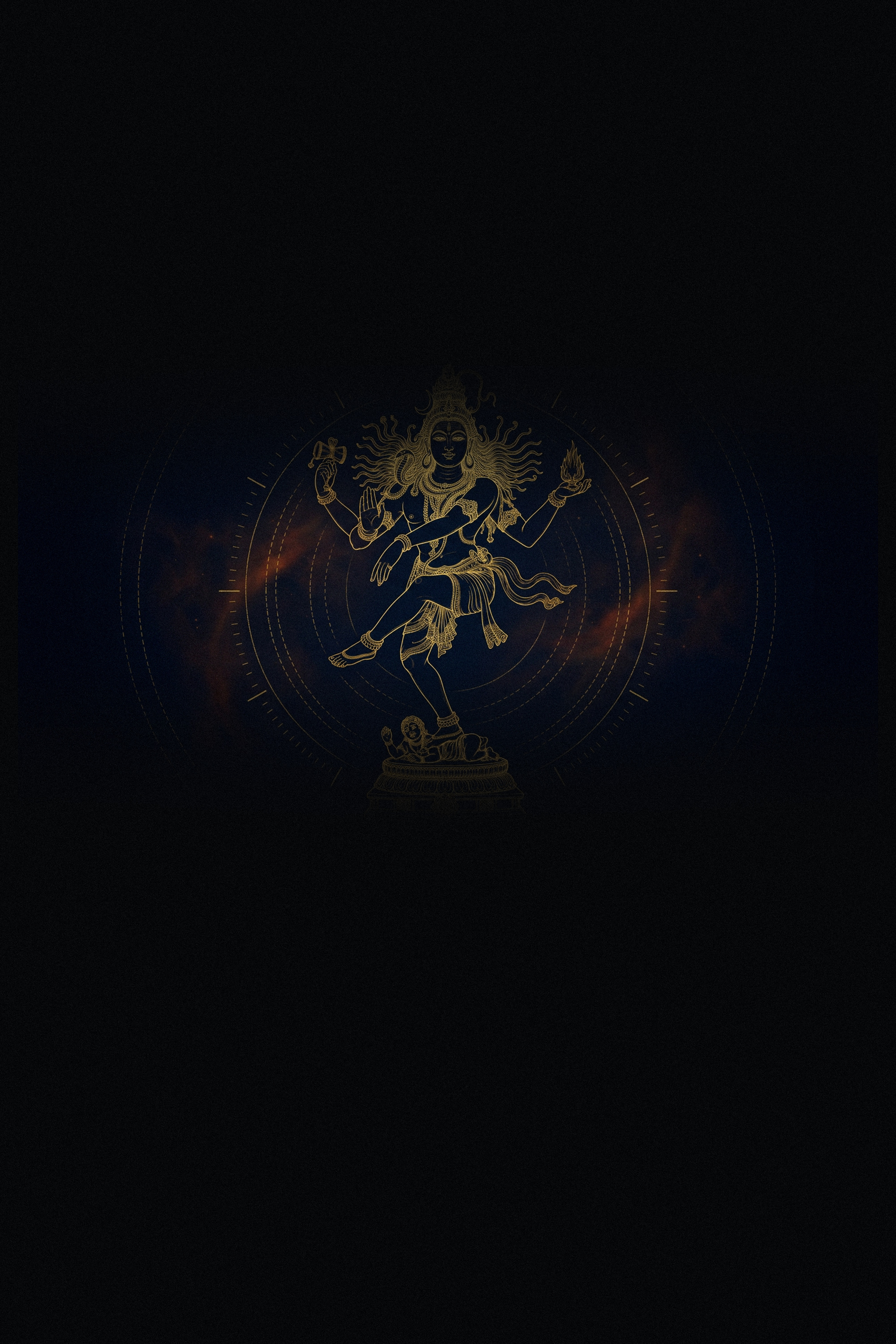
South Indian bronze casting uses the lost-wax method. A wax model is made in full detail, encased in clay, and then melted out and discarded. Metal is poured into the void the wax left. To obtain the object, the model must be destroyed.
It is also a workshop tradition of extraordinary discipline. Proportion is governed by canonical measure. The maker is not free to improvise the geometry. Within those constraints the work reaches a level of refinement that improvisation never reaches — the constraint is what makes the mastery legible.
Both properties are load-bearing here. This body operates under a canon of measure it did not invent and cannot casually vary. And it accepts that the model gets destroyed: the plan, the draft, the earlier framing are all consumed in producing the thing that lasts.
Pigment, wall and the public record

Mural traditions across the region encode narrative on walls in mineral pigment. The medium matters: a wall painting is public, fixed, and legible to an audience that has no access to manuscripts. It is the mass-communication layer of a pre-print society.
This volume takes the principle rather than the style. A record that only specialists can read is a record with a small failure surface. The canon therefore exists in registers — the technical diagram for the specialist, the plate for the reader who arrives through image, the plain statement for the person who has ten minutes and no background.
The node, stated plainly
Assemble the material floor and one description survives contact with the evidence: this littoral was a node — a place whose economic and cultural counterparties were reached by sea, whose script and metallurgy were continuous with a mainland tradition, and whose orientation was outward.
The node is the foundation of everything that follows. A node has standing to maintain its own record. A node can federate with other nodes without becoming a state. A node can be displaced across the world and remain a node, because its defining property was never territorial adjacency — it was connection.
The node is a historiographic reading, published with its sources, contestable in the open literature, and used as framing rather than as evidence for any specific accountability claim.
The reading is tested by scholars who owe this body nothing, cited or refuted in peer-reviewed work, and revised in public when refuted.
நிலம் பறிபோனாலும், வழி மிச்சம்.
Take the ground and the road remains.
What the long ground does not prove
Depth is a framing instrument. It is not evidence of a violation, not a legal argument, and not a substitute for the cited record in Parts III and VII. Nothing in this part should ever be cited to establish a contemporary fact.
- It does not prove entitlement to any territory.
- It does not establish that any community arrived before another.
- It does not carry evidentiary weight in any accountability process.
- It does not license the reading of ancient material as a modern political mandate.
Read the long ground as context. Read Part VII for the record that carries weight.
Part II
நடராஜா
The Grammar
Five acts on one body, read as a diagram of institutional behaviour. Analogy, never identity.
A warning before the reading
What follows reads a bronze as a diagram. It is not theology, and it is not physics. The distinction is not decorative — collapse it and the whole part becomes indefensible.
- Not as a religious claim. The image is devotional to millions; this reading has no standing over that meaning and does not compete with it.
- Not as physics. The correspondence between a dancing figure and particle behaviour is a twentieth-century literary conceit, not a result.
- Not as identity. The body does not claim to be the figure. It borrows a grammar.
- Not as a mandate. No sacred image authorises any political act in this volume.
What is taken is narrow and structural: the figure performs five distinct functions simultaneously on one body, and a stateless institution needs precisely that — a way to be several things at once without becoming incoherent.
பஞ்சகிருத்தியம்
Pancakritya as civic grammar
The classical reading assigns five acts to the figure: creation, preservation, dissolution, concealment, and release. This volume renders them as five verbs an institution performs, and holds itself to all five at once.
- Strikeபடைத்தல்
- Make things appear. Publish. The archive's first duty is that a record exists at all, and exists where it can be found.
- Holdகாத்தல்
- Maintain continuity. A published record that cannot be retrieved in a decade was never published; it was announced.
- Releaseஅழித்தல்
- Let go without scattering. Retire what is superseded, in public, with the reason recorded. Dissolution is a governed act, not an accident.
- Pressமறைத்தல்
- Hold down forgetting. Not concealment of truth — the suppression of the force that erases. The demon under the foot is amnesia, and it is pressed, not killed.
- Liftஅருளல்
- Leave the door open. The raised foot is the standing offer of return, to a reader, a critic, an institution, or an opponent who changes position.
Most organisations manage two or three. A campaign strikes and cannot hold. A library holds and never strikes. A bureaucracy presses and never lifts. The grammar is a demand that all five be performed on one body, permanently, and it is used in this volume as an audit instrument: any organ failing one of the five is failing.
Contained fire
The figure holds fire in an open hand, within a ring of fire that closes the composition. The flame is not thrown. It is also not hidden — it is presented, upward, in full view.
This is the single most important constraint in the volume, and it is an engineering constraint before it is an ethical one. Energy that is contained remains available. Energy that is discharged is gone, and the discharge is the moment the containing body loses its standing.
Applied: this body documents rather than accuses, cites rather than concludes, publishes rather than campaigns, and refuses every capability that would require the flame to leave the palm. Not because grievance is unwarranted — because a body that discharges once is thereafter read as a combatant, and a combatant's archive is evidence of motive rather than evidence of fact.
கையில் நெருப்பு. வீசப்படுவதில்லை.
Fire in the hand. Never thrown.
Containment is enforced by published refusals, by desk-level rules, and by a review step before anything is published.
Containment is structural — no organ possesses a capability that could be discharged, so restraint is not required of anyone's judgement.
முயலகன்
Muyalaka as the archive
Beneath one foot lies a small figure, pressed but intact. Read here as forgetting — the ordinary, continuous, unmalicious force by which a record decays into rumour and rumour into nothing.
Note what is not depicted. It is not killed. There is no version of this iconography in which the figure is absent, because the pressure is permanent and the pressing is the work. An archive is not a project that completes. It is a foot that stays down.
This is why the volume prints no completion date, no roadmap, and no target state that could be reached and celebrated. The moment an archive declares itself finished, the foot lifts.
The reading is analogical and internal to this volume. It carries no interpretive authority over the iconographic literature.
The raised foot
The other foot is lifted. In the devotional reading it is refuge. In this volume it is the door the body refuses to close: on the critic, on the sceptical institution, on the researcher who arrives hostile, and on anyone from any community who wishes to check the record.
Holding a door open has a cost, and the cost is that hostile readers get in. This volume accepts that cost explicitly. Every claim is printed with its authority precisely so that a hostile reader can check it, because the only durable form of credibility is the kind that survives someone actively trying to break it.
- Researchers whose conclusions oppose this body's framing.
- Institutions that have previously refused engagement.
- Members of any community named anywhere in the archive.
- Critics who publish against the archive using the archive's own citations.
The grammar as an audit instrument
| Act | The question asked of every organ | Failure signature |
|---|---|---|
| Strike | Did anything get published this era? | Activity without artefacts. |
| Hold | Is what was published still retrievable? | Dead links, moved files, lost provenance. |
| Release | Was anything superseded retired in public? | Silent deletion, quiet edits. |
| Press | Is decay actively resisted, or only noticed? | An archive that grows but is never re-verified. |
| Lift | Can a hostile reader enter and check? | Gated evidence, unpublished method. |
The grid is run against every organ in Part III. It is the cheapest governance instrument in the volume: five questions, no metrics, no dashboard, answerable by anyone holding the book.
Precedent and limits
Reading an inherited image as an institutional diagram is not novel. Legal and political traditions across the world have taken scales, columns, thrones and rings as compressed statements of how power should behave. The move is legitimate as long as it stays a reading and does not become a warrant.
The limit is strict. Nothing in this part authorises an action. If a proposed act can only be justified by the grammar and not by the Charter, the citations, and the law of the jurisdiction, it is not performed.
A diagram may describe an institution. It may never excuse one.
Part III
உறுப்புகள்
The Organs
Seven organs. Each one is defined as much by what it refuses as by what it does.
Why seven, and why they are fixed
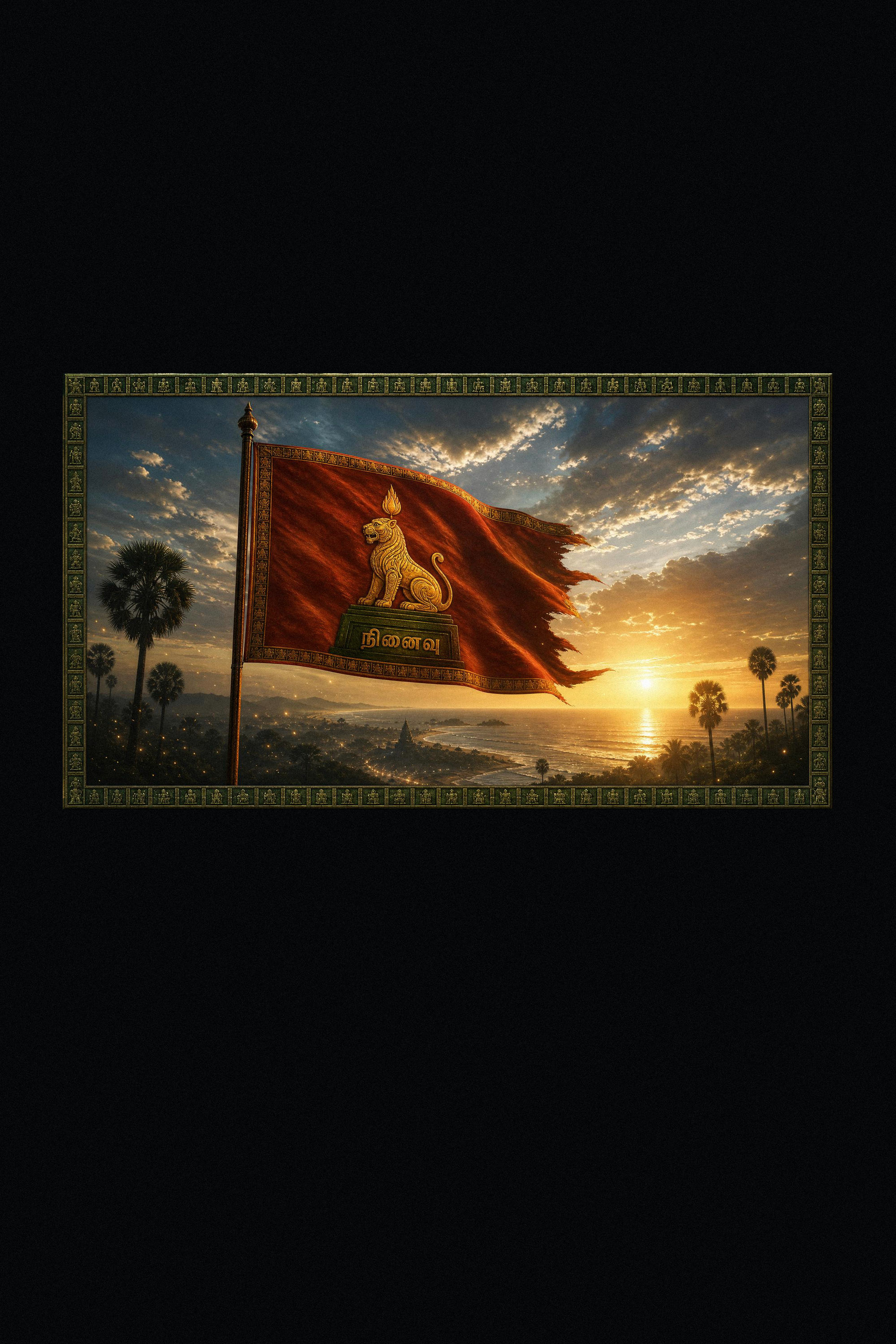
Seven organs, canonical. The number is fixed not because seven is significant but because an unbounded list is how institutions hide growth. A new function must either fit an existing organ or displace one, and displacement requires a published amendment.
Each organ below is set out identically: mandate, the refusals that bound it, its authorities, and the desks that carry the work. The refusals block is not an appendix to the mandate. In several organs it is longer than the mandate, and that ratio is deliberate.
| Organ | Tamil | Function in one line |
|---|---|---|
| Unmai | உண்மை | Preserve the record. |
| Velicham | வெளிச்சம் | Answer, with citation. |
| Aayvu | ஆய்வு | Study the pattern. |
| Magalir Avai | மகளிர் அவை | Hold the women's council. |
| The Case File | வழக்கு | State the scholarly position. |
| Kaaval | காவல் | Carry the canon in form. |
| Outreach | தொடர்பு | Correspond with institutions. |
உண்மை
Unmai — the preserving organ
Open-source preservation of an evidentiary record the body did not generate.
Unmai preserves. It collects, structures, cites and re-verifies material that is already public, produced by authorities with a mandate to produce it, and holds that material in a form that survives the removal of any single source.
It originates nothing. Every entry points to an external authority and is graded by tier: findings of treaty bodies and formal human-rights mechanisms at the top; established investigative journalism and credentialed NGO reporting below that; contested or single-source material marked as such and never used to carry an argument alone.
- Direct survivor intake. Testimony is routed to organisations with safeguarding capacity and legal standing.
- Naming perpetrators. Where a name exists in the record, the authority that published it is cited; the archive does not add one.
- Aggregating counts. Where a total is needed, the body holding that total is cited.
- Verdicts. The archive records what an authority found. It does not find.
- Photography, filming or geolocation of installations, checkpoints or serving personnel.
- Human sources. All collection is from open, published material.
A public, tiered, citation-anchored archive with desks organised by subject, each carrying its own refusals and referral block.
A mirrored, independently replicated standard that other archives adopt, where re-verification is scheduled rather than occasional.
Tiering rests on the status of the source institution, not on the archive's assessment of the claim.
வெளிச்சம்
Velicham — the answering organ
A grounded assistant that may only answer from the published corpus.
Velicham answers questions about the archive using only the archive. It retrieves from the published corpus and every load-bearing statement it returns carries a citation gloss pointing to the page that supports it.
Its most important behaviour is refusal. Asked something the corpus does not support, it says so and routes the reader to the authority that could answer. An assistant that improvises is worse than no assistant, because it converts a citation-disciplined archive into an unaccountable one at the point of contact.
- Answering outside the corpus, including from general knowledge.
- Speculation, prediction, or any statement about the future.
- Sealed material and anything era-gated.
- Legal, medical, or safety advice. These route to the named services.
- Any answer that would name an individual the archive does not name.
Retrieval over the published corpus with mandatory citation glosses, refusal behaviour, and no persistence of who asked what.
Every answer traceable to a content hash, so a reader can verify not only the source but the exact revision that produced the answer.
ஆய்வு
Aayvu — the studying organ
Method, models, and the discipline of stating what a model cannot do.
Aayvu builds and maintains the analytical instruments. Every model it publishes ships with four statements: what it measures, what it cannot measure, its failure mode, and the observation that would falsify it. A model missing the fourth statement is not published.
The organ's output is descriptive. It maps distributions, structures opinion space, indexes citations and measures the archive's own decay. It does not forecast, does not score individuals or districts, and does not produce anything that could be operationalised as a targeting instrument.
- Prediction of any kind, including risk maps and early-warning scores.
- Individual-level inference. Every published output is cohort-level with a stated floor.
- Models whose falsification condition cannot be stated.
- Publication of raw response data, regardless of anonymisation claims.
The instruments themselves are specified in Part IV.
மகளிர் அவை
Magalir Avai — the women's council
A standing council with the strictest refusal set in the volume.
Magalir Avai holds the council function on questions where the archive's ordinary methods are insufficient and the risk of harm is highest. Its posture is deference: it cites the specialist bodies, it never duplicates their intake, and it never becomes a destination for disclosure.
- Receiving reports, complaints, or testimony of any kind, on any surface.
- Naming any survivor, or any family of a disappeared person.
- Aggregating counts of conflict-related sexual violence or disappearance. The specialist bodies hold those figures and are cited.
- Claiming to provide safeguarding, legal, medical, or emergency services.
- Publishing any detail that could identify a person in a small community.
Every operational page under this organ carries a referral block that cannot be removed by any editor, in any edition, on any surface: emergency services in the jurisdiction of the reader, and the named specialist organisations for support and for testimony.
A public council surface, deference to specialist authorities, and a non-removable referral block.
Formal standing relationships with those authorities, so referral is a warm handover rather than a printed number.
வழக்கு
The Case File — the position organ
Scholarly positions, argued in the literature's own terms.
The Case File states positions on contested questions — labelling, proscription, comparative self-determination, design responsibility in colonial constitutional arrangements — by mapping the scholarly literature rather than by asserting a preferred conclusion.
It carries a rule that costs the body rhetorical force and buys it standing: the archive does not adopt contested labels in its own voice. Where a term is contested in the literature, the contest is printed, with the scholars on each side named and cited, and the reader is left to hold the tension.
- Adopting a contested label as the archive's own characterisation.
- Presenting a procedural legal outcome as a substantive one.
- Selective citation. Where a strong counter-argument exists, it is printed at equal length.
- Any argument that depends on the reader not checking the source.
காவல்
Kaaval — the form organ
Standards for the canon's physical and visual form.
Kaaval holds form: the flag standard and its construction geometry, the codices, the card and credential specifications, the icon system, and the rules governing how any of it may be reproduced.
Form is not decoration in a stateless body. It is the only thing that travels without explanation. A specification published with its geometry can be reproduced correctly by someone who has never met anyone in this organisation, and correct reproduction is what makes a distributed canon possible at all.
- Any form that reproduces, adapts, or gestures toward the insignia of a proscribed organisation.
- Any credential that functions as an identity document.
- Any specification that cannot be reproduced from the published geometry alone.
தொடர்பு
Outreach — the corresponding organ
Institution, never officer. Anchor, quiet window, published template.
Outreach corresponds with institutions. It operates under three binding constraints: the institution must already be cited somewhere in the archive before it is contacted; correspondence addresses the institution and never a named individual; and a quiet window follows first contact during which no follow-up is sent and no contact is publicised.
The template letter is public. The sent copy is not. This asymmetry is the point — anyone can audit the method, nobody can reconstruct a pressure campaign from the ledger.
- Naming any programme officer, mandate holder, editor, or elected representative.
- Publishing a list of institutions that did not reply.
- Any pressure framing, deadline, or escalation language.
- Fundraising, in any form, on any outreach surface.
Correspondence, not campaign. The difference is whether the recipient can say no without consequence.
The audit grid, applied
Part II's five questions are run against each organ every era and the result is printed. The grid is deliberately crude: it produces findings a reader can verify independently, rather than a score only the body can compute.
Part IV
கருவிகள்
The Instruments
The mathematics and the physics. Every model states what it cannot measure and what would falsify it.

The publication rule
A model that cannot be falsified is not a model. It is a rhetorical device with a coefficient attached, and it is more dangerous than having no model at all, because it borrows the authority of measurement without accepting the discipline.
Every instrument in this part is therefore published with four statements, in a fixed order. What it measures. What it cannot measure. Its failure mode — the way it breaks in practice, not in theory. And its falsification condition: the observation that, if made, obliges the body to withdraw or revise it in public.
The fourth statement is the expensive one. It converts an analytical asset into a standing liability, and it is the reason this part exists. An archive that publishes its own falsification conditions is making a bet that it would rather be corrected than believed.
- Prediction. No instrument in this volume forecasts an event.
- Individual-level output. Every published figure is cohort-level, with the cohort floor stated.
- Scoring people, districts, institutions, or communities.
- Publication of raw response data under any anonymisation claim.
- Any output that would be more useful to a security service than to a researcher.
Physics as method, not metaphor
Three principles borrowed as engineering constraints.
- Conservation
- Nothing enters or leaves the archive without a trace. Every addition, correction and retirement writes to an append-only changelog. If a page changed and the changelog does not say so, the archive has a defect, not a preference.
- Threshold
- Evidence does not strengthen continuously. It changes state. A claim supported by contested reporting and the same claim in a treaty-body finding are not different in degree — they are in different phases, and the archive treats the tier boundary as a phase change rather than a slope.
- Containment
- Energy held remains available; energy discharged is spent. Stated in Part II as grammar, it recurs here as a design rule: no organ is built with a capability that could be discharged, because a capability that exists will eventually be used by someone under pressure.
These are constraints adopted by analogy. This volume makes no claim about physical law and cites none.
Instrument I — the citation lattice
Citation Lattice மேற்கோள் வலை
Promotion requires an independent path to a higher-tier source, not additional citations at the current tier. Formally: tier(c) = max over independent source paths, not a count.
- Measures
- The evidentiary state of every load-bearing claim in the archive, expressed as a discrete tier derived from the status of the source institution.
- Cannot measure
- Whether a claim is true. The lattice measures the standing of the body asserting it, which is a proxy and is stated as one.
- Failure mode
- Tier inflation. A widely repeated claim accumulates citations from sources that are all downstream of one original, and the volume of references is mistaken for independence.
- Falsified by
- A sampled audit finds that claims at the highest tier are corrected at a rate indistinguishable from the tier below. If tiers do not separate error rates, they encode nothing.
Instrument II — opinion space
Dimensional reduction over statement agreement, with differential privacy.
The opinion-mapping instrument takes agree, disagree, or pass responses to short statements and projects the resulting sparse matrix into two dimensions by principal component analysis, then partitions the projection into cohorts by k-means. It reports which statements a cohort agrees on and, more usefully, which statements bridge cohorts that otherwise diverge.
Opinion Space கருத்து வெளி
PCA to two components over the response matrix; k-means over the projection; Laplace noise added to all published counts at ε ≤ 1.0; no cohort published below a floor of 25 participants.
- Measures
- The structure of agreement across a self-selected participant set: how many distinct positions exist, and which statements are shared across them.
- Cannot measure
- Anything about the population. Participation is self-selected and unweighted, so the output describes the participants and nobody else. It is not a poll, not a referendum, not a census, and not a mandate.
- Failure mode
- Brigading. A coordinated group enters at volume, forms an artificial cluster, and the map reports a manufactured position as a natural one.
- Falsified by
- Two independent participant sets drawn under the same conditions produce cluster structures that do not correspond. If the geometry is not reproducible, it is an artefact of who arrived.
- Any live map. Only archival readings, taken at era intervals, are published.
- Per-statement live counts, which would allow a participant to infer another's response.
- Any identifier. Participation is cookie-pseudonymous with a per-set salted hash; no phone, no email, no biometric.
- Any framing as a vote. It is not an election and is never presented in an election's visual language.
The dimensional-reduction and clustering approach follows published open-source deliberation methods; the privacy parameters and the cohort floor are this body's own and are stated so they can be criticised.
Instrument III — the return index
Return Index
A ratio over two published series, reported with the series named, the reporting period, and the definitional caveats of both.
- Measures
- The observed relationship, in published data, between educational output in a region and the retention of that output within the region.
- Cannot measure
- Cause. It reports a gap between qualification and local absorption; it does not identify why, and it cannot distinguish between opportunity, choice, and coercion.
- Failure mode
- Denominator drift. Administrative categories change between reporting periods and the index reads a definitional change as a real movement.
- Falsified by
- The index moves in the opposite direction to the underlying published series when both are recomputed from source. Any divergence from the primary series falsifies the index, not the series.
The index exists to make a gap visible using figures the relevant authorities already publish about themselves. Its power is entirely borrowed: if the underlying series is disputed, the index is disputed with it, and that dependency is printed rather than hidden.
Instrument IV — the refusal engine
Refusal Engine மறுப்பு இயந்திரம்
- Measures
- Whether every operational refusal in the archive is bound to a named external instrument — a statute, a treaty article, a professional standard, or a published safeguarding rule.
- Cannot measure
- Whether the refusal is wise. It checks that a refusal has an external anchor, not that the anchor was correctly chosen.
- Failure mode
- Anchor drift. An instrument is amended or superseded and the refusal continues to cite the old version, so the refusal looks anchored while floating free.
- Falsified by
- An audit finds a refusal in force whose cited instrument does not, on reading, support it. One such finding invalidates the engine's guarantee and requires a full re-audit.
This is the instrument that makes the refusals in this volume checkable rather than admirable. A reader can take any refusal, follow it to the named instrument, read the instrument, and disagree — which is the entire point.
Instrument V — the gate ladder
Gate Ladder
- Measures
- Which capabilities are unlocked, expressed as conditions rather than dates. Each gate is a stated, checkable condition; a capability is available only when its gate is open.
- Cannot measure
- When a gate will open. The ladder deliberately contains no time dimension.
- Failure mode
- Gate erosion. A condition is quietly reinterpreted so that a gate reads as open without the underlying condition changing.
- Falsified by
- A capability is found in use while its gate is, on the published condition, closed. This is a governance failure and is recorded as one in the changelog.
The ladder is why this volume prints no roadmap. A roadmap promises time, which no stateless body controls. A gate promises a condition, which anyone can check.
Instrument VI — the continuity orrery
Continuity Orrery
Survival is treated as a function of independent replicas, not of storage durability at any one replica.
- Measures
- The archive's survival surface: how many independent copies exist, across how many custodians, in how many jurisdictions, and how long since each was verified.
- Cannot measure
- Whether any copy is faithful. It counts copies and verification events; fidelity is established by hash comparison, which is a separate check.
- Failure mode
- Correlated custody. Several copies appear independent but share a hosting provider, a jurisdiction, or a single responsible person, so one event removes them together.
- Falsified by
- A simulated loss of the largest single custodian leaves the record unreadable. If removing one node breaks the archive, the orrery has been reporting redundancy that does not exist.
ஒரு பிரதி ஒன்றுமில்லை. பல பிரதிகள் தான் நினைவு.
One copy is nothing. Many copies are memory.
Instrument VII — the decay clock
Decay Clock
- Measures
- For every cited claim, the elapsed time since its source was last confirmed reachable and unchanged. The archive's own rot, measured against itself.
- Cannot measure
- Whether an unreachable source was correct when cited. A dead link is a continuity failure, not a truth failure, and the two are reported separately.
- Failure mode
- Verification theatre. An automated reachability check passes because a URL resolves, while the document behind it has been silently replaced.
- Falsified by
- A manual sample finds sources marked verified whose content has materially changed. The clock then measures nothing and must be rebuilt around content hashing.
This is the instrument most institutions never build, because it can only produce bad news about its owner. It is printed here for exactly that reason: the press of the foot in Part II, expressed as a number.
Decay is checked in review passes and corrections are recorded in the changelog.
Every claim carries a content hash of its source at time of citation, and drift is detected automatically rather than noticed.
What the instruments are for
None of these instruments produces a conclusion. That is not a limitation; it is the specification. A stateless body that produces conclusions is asking to be believed, and it has no standing to be believed. A body that produces method is asking to be checked, and checking is a request any institution can grant without conceding anything.
Do not believe the archive. Check it. It was built to be checked.
Part V
செயல்பாடு
The Operation
Governance, the firewall between the standards body and the operating body, and what a Tuesday actually looks like.

Power without capture
Power is held, but never concentrated. Authority is procedural, not personal. There is no founder override, no permanent seat, and no emergency power.
The phrase is deliberately short so it can travel, and deliberately falsifiable so it can be retired. If this body ever installs a single permanent leader, an emergency override, or a founder-only power, the phrase becomes a lie and must be struck from every surface.
It is not a critique of any government and not a marketing line. It is a one-sentence description of an architecture, printed so the architecture can be checked against it.
The three core laws
- Distributed authority
- No single person, council, or office holds final say. The Charter and the councils are the architecture. There is no chief, no president, no life seat, and no override.
- Reversibility
- Every decision can be revisited. Seats rotate. Holders can be recalled. The stewardship register is public. Nothing is permanent except the Charter, and the Charter is amendable by a published procedure.
- Visible process
- Decisions and their reasons are published. Identities and vulnerability maps are not. Transparency without exposure — the inverse of both opaque governance and surveillance-style radical openness.
Three laws, not five. A new contributor can recite them from memory on the first day. A fourth would dilute their force; if a future amendment needs one, it must replace a law rather than extend the list.
The laws are written, published, and binding on every council decision.
The laws are tested by real rotation cycles, real recalls, and real cross-council confirmation, and survive adversarial pressure.
The councils
The councils do not align to a central authority; they align to the three laws. Each holds a domain, each confirms appointments in another's domain, and none can complete a constitutional act alone. Cross-confirmation is the mechanism that makes capture expensive: taking one council yields nothing.
| Mechanism | Now (Aarambam) | Becoming (Nilaiththanmai) |
|---|---|---|
| Rotation | Written into the Charter with terms defined. | Executed on schedule, with handovers recorded. |
| Recall | Procedure published. | Exercised at least once without the body fracturing. |
| Register | Stewardship register exists and is public. | Independently mirrored so it cannot be quietly edited. |
| Amendment | Procedure published, no founder exception. | An amendment passes against the founder's stated preference. |
The right-hand column is the test set. Until each has occurred, the governance claim in this volume is architectural rather than demonstrated, and is printed as such.
The firewall
The most legally consequential diagram in this volume.
Two vehicles, one line between them. Confusing them would collapse the entire architecture, so the separation is printed as a diagram rather than described in prose.
- The standards body
- A community interest company in the jurisdiction of incorporation. It publishes doctrine, holds the archive, cites external authorities, and maintains the canon. It owns nothing operational anywhere in the homeland, holds no property there, employs nobody there, and never will while this Charter stands.
- The operating body
- A separate company in the same jurisdiction. It does what a standards body must not: enter contracts, take payments as agent, hold copyright in commissioned work, procure hardware, and carry commercial risk.
What crosses the line: published standards, in one direction only. The operating body may adopt a published standard exactly as any third party may. What never crosses: money into the archive's editorial decisions, commercial priorities into the citation tiers, and operational obligations into the standards body's name.
- Any homeland ownership, tenancy, employment, or operational presence by the standards body.
- Any commercial relationship that would make an archive finding financially consequential to the operating body.
- Any shared officer with unilateral authority on both sides.
- Any funding arrangement that is not disclosable in the register.
One body writes the standard. A different body carries the risk. The line between them is the institution.
How the operating body works
The operating body exists because certain necessary functions are hazardous to a standards body. Someone must be able to sign a contract, hold a copyright, or take a payment, and a body that does all three loses the disinterestedness that made its findings worth citing.
- Agency, not custody
- Where payments are handled, they are handled as agent on behalf of a named counterparty, settling to that counterparty, with the arrangement disclosed. The operating body does not hold value on anyone's behalf and does not operate any instrument that would require it to.
- The copyright engine
- Commissioned recordings, oral histories and craft documentation are held under clear, published licence terms in a stable jurisdiction. Rights sit where they can be enforced and where a licence, once granted to the public, cannot be retracted by pressure applied elsewhere.
- Contribution credit
- An internal, non-tradable marker of contribution. It is not currency, has no exchange, no redemption for money, and no secondary market. It recognises work inside the platform and nothing outside it.
Contribution credit is an internal marker powering recognition inside the platform, with no external exchange of any kind.
A pure non-tradable energy marker of contribution, structurally incapable of exchange rather than merely prohibited from it.
- Holding client funds, issuing any instrument redeemable for value, or operating anything requiring a payments authorisation it does not hold.
- Possession of third-party evidentiary files. It never becomes a custodian of other people's recordings.
- Ambient monitoring of any kind, in any product, on any surface.
- Any homeland operation while the current era gate is closed.
The observational layer
Constraints first. Capabilities second, and only inside them.
The archive operates an observational layer over published material. It is described here by its limits before its functions, because the functions are unremarkable and the limits are the only part that matters.
- No autonomy. Nothing it produces reaches any surface without human review.
- No targeting, of any person, group, institution, or location.
- No naming of individuals.
- No autonomous communication with anyone outside the body.
- No offensive capability of any kind, and no capability that could be repurposed as one.
- No collection from human sources. Open, published material only.
Within that envelope it does routine, dull work: retrieving published material, structuring it, flagging where a cited source has changed, and preparing template-bound summaries for a human to accept or reject. It is described accurately as dull because accuracy here is a safety property.
Observational, template-bound, human-reviewed before publication, operating only over published sources.
The same envelope, with the review step and its rejections recorded in the changelog so the human check is itself auditable.
Continuity protocol
The continuity protocol answers one question: if the people currently doing this work stopped, what would survive? The answer must be independent of anyone's goodwill, including the founder's.
- 01The changelog is append-only. Corrections extend the record; they never overwrite it.
- 02The canon exists in at least four media with different failure modes: live web, print, deposited copies in national collections, and a content-hashed source bundle.
- 03Custody is distributed across jurisdictions. No single holder can withdraw the record.
- 04Deposit is treated as the base layer. Once copies sit in national legal-deposit collections, the canon has passed beyond any single decision — including a decision by this body.
- 05Every refusal in force is published, so a successor can tell whether the body has drifted from its own constitution.
Continuity is not loyalty. It is redundancy with the paperwork done.
What a Tuesday looks like
Doctrine that cannot be operated is a press release. This section describes the ordinary week, because the ordinary week is where the architecture either holds or quietly stops being true.
- A cited source is re-checked. It has moved. The citation is updated and the change is written to the changelog with the old location retained.
- A question arrives that the corpus does not support. The answering organ refuses and routes the reader to the authority that could answer.
- A desk drafts a page. Review finds a claim with only one layer. The page does not publish until both layers are resolved.
- A correspondence template is prepared for an institution already cited in the archive. The institution is named; no individual is.
- Someone proposes a capability that would be genuinely useful and sits outside a closed gate. It is refused and the refusal is recorded, which is the only reason the gate means anything.
None of the above is impressive. That is the finding. An institution is what remains once the impressive part is removed.
Part VI
கோடெக்ஸ்
The Codices
The visual canon. Specifications precise enough to be reproduced by a stranger.

Why form is published as specification
A distributed body cannot police its own appearance. It can only publish geometry precise enough that correct reproduction is easier than incorrect reproduction.
Everything in this part is therefore given as construction: ratios, angles, sequences and tolerances rather than adjectives. A reader with no contact with this organisation should be able to reproduce any of it correctly from the printed page alone.
- Any device that reproduces, adapts, or gestures toward the insignia of a proscribed organisation.
- Any object that could function or be mistaken for an identity document.
- Any specification that cannot be reproduced from the published geometry alone.
- Any form whose meaning depends on a private explanation.
The Fire-Codex — six acts
| Act | Holds | Closing instrument |
|---|---|---|
| Ground | The material floor and the long depth. | The lattice. |
| Word | Language, naming, and what the archive will not call things. | The refusal engine. |
| Reckoning | The cited record and its tiers. | The model bench. |
| Force | Restraint, containment, and the refusal of capability. | The enclosure. |
| Registry | Continuity, custody, and the changelog. | The orrery. |
| Light | Publication, retrieval, and the open door. | The gate ladder. |
Each act closes with a live instrument rather than a conclusion. The instrument is the argument: a reader who works it reaches the finding themselves, and a finding reached by the reader is the only kind that survives disagreement.
The Kaaval Codex
The Kaaval Codex governs the card and credential forms. Each object carries a face, a register mark, and a resolution path — a route by which anyone holding the object can reach the published page that defines it. An object with no resolution path is not part of the canon.
- No credential asserts identity, nationality, membership of any state, or any entitlement.
- No object carries personal data on its face.
- No object is required for access to anything in the archive.
- No scarcity mechanic, no secondary market, no speculative framing.
The standard — construction geometry
The standard is defined by proportion rather than by dimension, so it is correct at any size. The construction gives the field ratio, the division points as fractions of the hoist, the placement of the central device on the intersection of two stated lines, and the permitted tolerance.
Colour is specified as coordinates, not as names. Names drift between printers, screens and languages; coordinates do not. Where a printer cannot achieve a value, the specification states which direction to err.
The construction is published with its geometry and reproduced correctly by third parties without contact with this body.
The construction is stable enough that a variant can be identified as a variant by measurement rather than by argument.
Sudarkkal — the entry stone
The entry stone is the canon's densest object: a cut bipyramid in black, banded at the equator in gold, carrying a single flowering form held inside the body of the stone rather than applied to its surface.
- The bipyramid
- Two apexes, one body. The upper apex is the published surface; the lower is the ground it rests on. Neither is the front.
- The band
- A single equatorial line. It is the only continuous element and reads as a horizon at any orientation. It marks the boundary between what is published and what is held.
- The bloom
- The contained flame of Part II, rendered as a flower. Inside the stone, visible, never emerging. It is the same constraint stated in a form that can be held in a hand.
The stone's geometry generates the icon system used throughout this volume: the 24-unit grid, the single stroke weight, and the fill rule in which a solid mark is operational now and an outline mark is becoming. Every icon in the book is a descendant of this object.
- Any function as identification or entitlement.
- Any numbered scarcity, edition premium, or resale framing.
- Any personal data, on the object or in any register tied to it.
வெட்டப்பட்ட கல். உள்ளே எரியும்.
Cut stone. Burning inside.
The icon system
- 01All marks are constructed on a 24-unit grid. No element falls off the grid.
- 02One stroke weight throughout, scaled proportionally. Mixed weights are a defect.
- 03Angles derive from the stone: the apex angle and its bisector are the only permitted diagonals.
- 04No rounded terminals. No gradient. No shadow.
- 05Fill carries meaning and nothing else. Solid is operational now; outline is becoming.
- 06Colour is gold on black or black on gold. There is no third combination.
The rules are restrictive so that a mark drawn by someone who has never seen the others still belongs to the family.
The three registers, specified
| Register | Carries | Rules |
|---|---|---|
| Plate | Depth, grammar, the objects. | Full bleed. Warm. Falloff to black at the foot so type never fights the image. |
| Diagram | Architecture, method, geometry. | Hairline gold on black. No shading, no gradient, no perspective. |
| Prose | Argument, refusal, governance. | No image. Wide outer margin. Nothing decorative. |
The registers are never mixed on a single page. A reader who distrusts the plates can read the diagrams and reach the same findings; a reader who arrives through image can move inward. The separation is a redundancy measure, not a style preference.
Part VII
பதிவேடு
The Register
The audit surface. Evidence tiers, the changelog, the complete refusals index, and the colophon.

The cited evidence registry
Every load-bearing claim in the archive resolves to an external authority. The registry is the index of those authorities, graded by tier, with the date of last verification and the location at which the source was found.
| Tier | Source class | Use in this volume |
|---|---|---|
| A | Treaty bodies, formal human-rights mechanisms, courts of record, national statute. | May carry a claim alone. |
| B | Established investigative journalism, credentialed research organisations, peer-reviewed scholarship. | May carry a claim with a second independent source. |
| C | Single-source, contested, or newly emerging material. | Recorded and marked. Never carries a claim. |
| — | The body's own statements about itself. | Marked as such. Never presented as external verification. |
A claim does not rise a tier by being repeated. Promotion requires an independent path to a higher-tier source. This is the single rule that separates an archive from an echo.
The continuity changelog
Append-only. Every correction, retirement, tier change and refusal amendment is recorded with its reason. Entries are never edited and never removed; a wrong entry is corrected by a later entry that says so.
The changelog is the only place in the archive where the body's mistakes are systematically collected. This makes it the most valuable page for a hostile reader and, for the same reason, the most valuable page in the volume.
The changelog exists, is public, is append-only by rule, and is written by hand.
It is append-only by construction rather than by discipline, and independently mirrored so its history cannot be rewritten.
The refusals index
Every refusal in this volume, collected.
Refusals are printed at their point of use throughout the volume and collected here so they can be read as a single instrument. A body's constitution is more accurately described by this list than by its stated aims.
- Sovereignty · No claim of territory, taxation, citizenship, or authority against any state.
- Force · No armed, security, or protective capability of any kind.
- Naming · No naming of perpetrators, serving personnel, survivors, or families.
- Counting · No aggregated atrocity figures produced in-house.
- Intake · No direct survivor intake on any surface.
- Verdict · No findings, forecasts, scores, or risk maps.
- Glorification · No adaptation of, or gesture toward, proscribed insignia.
- Covert action · No clandestine unit, no human sources, no capability that cannot be published.
- Time · No calendar dates, no roadmap, no promised feature.
- Solicitation · No donation appeal, pricing, or call to action inside the canon.
- Autonomy · No autonomous action by the observational layer; human review before any surface.
- Custody · No possession of third-party evidentiary files.
- Monitoring · No ambient monitoring in any product, on any surface.
- Homeland operation · No ownership, tenancy, employment, or operational presence by the standards body.
- Individual output · No published figure below the stated cohort floor.
- Officers · No naming of programme officers, mandate holders, editors, or elected representatives.
- Language · Never the word that reduces a member to a consumer of a product.
Each refusal is bound to an external instrument by the refusal engine specified in Part IV. A refusal whose instrument no longer supports it is a defect and is corrected in the changelog.
Glossary
- Aarambamஆரம்பம்
- The founding era. The present layer of every claim in this volume.
- Nilaiththanmaiநிலைத்தன்மை
- The becoming layer. The civilisational target, never dated.
- Organ
- One of seven canonical functions. The number is fixed; addition requires displacement.
- Desk
- A subject-scoped working surface inside an organ, carrying its own refusals and referrals.
- Gate
- A published condition governing a capability. Open, closed, or contested. Never scheduled.
- Gloss
- A citation anchor attached to a load-bearing claim, naming the authority that supports it.
- Register
- Both the audit surface of Part VII and one of the three visual systems of the volume. Context distinguishes them.
- Tier
- The discrete evidentiary state of a claim, derived from the standing of its source institution.
Colophon and deposit
This edition is marked by era, not by date. It carries an identifier, a digital object identifier for the canon, and a content hash of the source bundle from which it was set. A reader can verify that a copy in hand corresponds to the published source by comparing the hash.
Copies are placed with national legal-deposit collections. Once deposited, the canon exists inside state-maintained holdings, permanently, regardless of what happens to any domain, host, company, or person named anywhere in this volume — including its authors.
This is the deepest instrument in the book and it costs postage.
The volume is set in a serif for argument, a monospace for function, and a Tamil serif that is never subordinate to either. The Tamil edition is authored, not translated: the same content, a different voice, neither one the original.
நெருப்பால் எழுதப்பட்டது. காற்றால் எடுத்துச் செல்லப்படும்.
Written with fire. Carried by wind.
மேற்கோள் முறை
How to cite this volume
Cite by part and section coordinate, not by page. Coordinates are printed in the outer margin of every leaf and do not move between editions or trims.
Transformative League of Tamil Eelam, Tī Nūl · The Fire-Book, Aarambam edition, section IV.3. The digital edition is maintained at docs.tlte.cloud/canon.
Where a later edition tightens a rule, the earlier text remains in the Continuity Changelog. Nothing in this volume is removed. Corrections are issued as additions.
OHCHR reports and country files, the Report of the Secretary-General's Panel of Experts, OISL, treaty-body concluding observations, and Human Rights Council resolutions. Cited as the highest anchor available.
Human Rights Watch, Amnesty International, International Crisis Group, the International Commission of Jurists, and peer-reviewed scholarship. Used where no Tier A anchor exists.
Named journalism and published civil-society statements. Carried only with the tier stated on the page, and never presented as verified.
- BAdayaalam Centre for Policy Research
- BAmnesty International
- BCentre for Policy Alternatives
- BGlobal Survivors Fund
- BHuman Rights Commission of Sri Lanka
- BHuman Rights Watch
- BInternational Commission of Jurists
- BInternational Crisis Group
- BInternational Truth and Justice Project
- AOffice of the United Nations High Commissioner for Human Rights
- AOHCHR Investigation on Sri Lanka (OISL)
- BPEARL — People for Equality and Relief in Lanka
- ASecretary-General's Panel of Experts on Accountability in Sri Lanka
- AUnited Nations Human Rights Council
- AUnited Nations Working Group on Enforced or Involuntary Disappearances
- BVerité Research
- Unmaiஉண்மை
- The record organ. Preserves, never accuses.
- Velichamவெளிச்சம்
- The answering layer. Cites or stays silent.
- Aayvuஆய்வு
- The study organ. Publishes method with result.
- Magalir Avaiமகளிர் அவை
- The women's council. Defers, never intakes.
- Kaavalகாவல்
- The safety standard. Publishes rules, holds no force.
- Kanakkuகணக்கு
- The accounting organ. Zero cash handling.
- Thodarcchiதொடர்ச்சி
- Continuity. Append-only; may tighten, never loosen.
Nothing in this volume is removed. Corrections are issued as additions and recorded in the Continuity Changelog. A later edition may tighten a rule; it may never quietly loosen one.
The Continuity record is public and append-only. If this body ceases, the record does not: it is deposited, mirrored and citable without the body's permission.
Set in Cormorant Garamond with Noto Serif Tamil; marginalia and coordinates in Geist Mono. Both scripts sit on one thirteen-point baseline so that facing pages back each other exactly.
The frame is a single gold hairline held at a fixed distance from trim on every leaf, mirrored at the gutter, with a dead band inside it that no glyph may enter. Blanks and plates carry the same frame as text pages.
Diagrams are drawn on a twenty-four unit grid derived from the Sudarkkal bipyramid. Plates are original to this volume. No stock photography appears in these pages.
தீ நூல் · Tī Nūl — The Fire-BookAARAMBAM EDITION · FIRST DEPOSIT · VOLUME IErrata are issued as additions to the Continuity Changelog and reprinted in the next edition. This leaf is left open for the reader's own hand.
நெருப்பால் எழுதப்பட்டது. காற்றால் எடுத்துச் செல்லப்படும்.
Written with fire. Carried by wind.
Transformative League of Tamil Eelam
docs.tlte.cloud